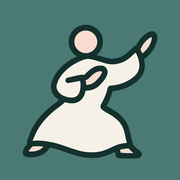
The sequence lifts both hands, draws a bow, raises one hand, looks back, sways, folds towards the feet, extends the fists and raises the heels. These are eight movement groups; the complete routine also includes an opening, transitions, repetitions and closing.
Find the movement you are learning
The order below follows the General Administration of Sport of China’s Health Qigong Baduanjin list. English names vary between teachers; these short labels and pinyin help identify the same Chinese movement. The common names do not replace the version’s technical instructions.
| Order | English name and pinyin | Main action | What to watch |
|---|---|---|---|
| 1 | Two Hands Hold Up the Heavens (Liang Shou Tuo Tian) | Both hands rise and lower. | How the hands travel up, separate and return. |
| 2 | Drawing the Bow (Zuo You Wan Gong) | Draw to each side. | The outward and drawing hands, return and side change. |
| 3 | Raising One Hand (Dan Ju), also called Separate Heaven and Earth | One hand rises as the other presses down. | Both hands move together and exchange roles. |
| 4 | Looking Back (Wang Hou Qiao) | Look to either side behind. | How the head and arms coordinate; not just a neck twist. |
| 5 | Swaying the Head and Tail (Yao Tou Bai Wei) | The torso follows a swaying route. | Foot position and support before the body’s path. |
| 6 | Reaching Towards the Feet (Liang Shou Pan Zu) | Fold and return upright. | The hand route and return; touching the feet is not the learning goal. |
| 7 | Clenching the Fists and Gazing (Zuan Quan Nu Mu) | Extend and return a fist. | Turning and withdrawing the hand, then changing sides. |
| 8 | Raising and Lowering the Heels (Bei Hou Qi Dian) | Heels rise and return. | Heel movement rather than jumping or stamping. |
Some English sources use Drawing the Bow to Shoot the Hawk or Eagle, Wise Owl Gazes Backwards, and Bouncing on the Toes. These are naming variations, not instructions to alter the movement. Longer traditional names include health-related language; read them as historical identifiers.
Start with the opening and first movement. Then study Drawing the Bow and Raising One Hand, especially the difference between an ordinary return and a final transition.
Continue in order with Looking Back, Swaying the Head and Tail, Reaching Towards the Feet, Fists and Wrist Turn, Raising and Lowering the Heels and the closing. Each lesson distinguishes entry, the complete route and its final transition.
Why can I recognise poses but not connect them?
A still image shows one moment. It may not show how the hands enter, return or change sides. The end of a bow-drawing pose alone cannot explain its connection to the third movement.
Watch the passage before and after the familiar shape. Identify entry, main change and exit. Names make a useful directory; hands, feet and transitions still need the detailed instructions from the same version.
Do the traditional names establish health effects?
No. References to regulating internal functions, strengthening the kidneys or dispelling illnesses are traditional names and explanations. They are not modern diagnoses, outcome measures or promises to cure disease.
Health questions need separate evidence: what was measured, in whom, and against which comparison? Read Baduanjin health research rather than inferring effects from a verse.
How do eight movements, a side and a whole set differ?
Eight movements means eight main groups. A group can contain left/right changes and repetitions. A complete set includes the chosen version’s opening, repetition arrangement, transitions and closing. Looking at eight pictures is not the same as practising the full sequence.
Check whether the teacher counts left and right separately or as one pair. The traditional reference to seven heel movements does not mean every other movement repeats seven times. See choosing a version.
References and sources
- General Administration of Sport of China: Eight Baduanjin movement shapes
Published 6 March 2013. Chinese names and order of the eight movements; still images do not replace full routes and transitions. English-name verification is recorded separately.
- Chinese Health Qigong Association: Health Qigong and traditional Baduanjin
Chinese Health Qigong Association, 14 December 2018. Checked its account of the eight shapes and verses, opening, closing, transitions, order and repetitions. This explains a version, not clinical effects.
- Baduanjin qigong: common English movement names
Checked 20 October 2026 only for English naming variants. Secondary reference, not the source of movement technique or health claims. Sequence and steps follow the original Chinese institutional materials; these are not claimed as a single official English translation.