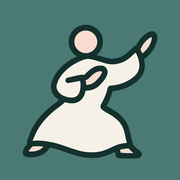
Move the hands through the armpits and down the back before folding. Reach forward to rise. Finish with the palms pressing down in front of the lower abdomen.
Lift from the fifth movement’s return
This continues the same standing Health Qigong Baduanjin used in the first three lessons. The route follows the General Administration of Sport demonstration around 09:18–11:22, checked against the 2018 technical corrections. Left and right mean your own sides. Times locate the passage, not a required personal pace or range.
Complete the fifth movement’s final step and press: feet parallel around shoulder width, knees slightly bent, palms down before the lower abdomen. Gradually straighten the legs, turn the fingertips forward and lift the arms in front and overhead, palms forward. There is no alternating step.
This passage includes a substantial forward fold, shoulder rotation and rise. Reaching the feet is not a requirement for everyone. Stop if the movement is not manageable; do not bounce, pull hard or lift the head abruptly to copy the range.
Move through the chest and armpits first
- Rotate the arms outward with palms facing each other. Bend the elbows and lower the hands past the face to the chest, turning the palms down and fingertips toward each other.
- Turn the palms upward. Keep the hands below the elbows and send the fingers backward through the armpit area, rather than reaching over the shoulders.
- Place the palms against the back and travel down either side of the spine toward the buttocks. Keep the torso upright and gaze forward during this part.
The corrections distinguish the order: send the hands back, move them down the back, then begin the fold as they pass below the buttocks and the elbows lengthen. Do not fold while the hands are still high on the back.
Continue down the back of the legs
- Continue from the buttocks down the backs of the legs as the torso gradually folds forward. Do not add a squat in place of this route.
- In the demonstration the hands reach the ankles, pass around the outsides of the feet and turn onto the tops, fingers forward. The legs remain extended and both sides work together.
- Pause briefly before reaching the arms forward. Touching the feet, moving lower or creating a stronger stretch is not a required outcome.
This describes the selected version. It does not invent a chair, stool or bent-knee replacement sequence. Obtain separate guidance when you need an alternative suited to your circumstances.
Let the arms lead the rise
- Reach the hands forward from the folded position, bringing the arms toward the sides of the head. Identify the moment the hands leave the feet and travel forward.
- Continue reaching forward and upward as the torso rises with the arms. Do not stand the torso upright first and add the arms afterward.
- Finish upright with the arms overhead, palms forward and hands around shoulder width. For another repetition, return through the chest and armpits to the back and repeat the same downward route.
The corrections identify rising before lifting the arms as an error. Leading with the arms does not mean swinging them to yank the body up or jerking the neck first.
Finish with a press instead of another fold
The demonstration counts one descent and return as one repetition and performs six. This identifies the arrangement rather than prescribing a personal dose. After the final overhead return, do not send the hands through the armpits again.
- Lower both arms in front with a slight elbow bend. Press before the lower abdomen, palms down and fingers forward.
- Let the knees bend slightly, face forward and retain the shoulder-width stance.
- Finish this return before the seventh movement’s step and fist extension. Do not change into horse stance while still folded.
Check the hand route and order of rising
- If you fold while the hands are still high on the back, review the upright part of their descent.
- If the hands reach over the shoulders, review the chest turn and route through the armpits.
- If you are upright with the arms still hanging, review the forward reach that leads the rise.
- If standing up causes dizziness or repeated discomfort, stop rather than adding repetitions to get used to it.
The traditional reference to strengthening the kidneys and waist is a name, not evidence of treatment for kidney or spinal disease.
Begin with natural breathing. A brief pause does not require holding your breath or forcing a larger movement. Traditional names identify the sequence; health effects need separate research evidence.
References and sources
- General Administration of Sport: continuous Health Qigong Baduanjin demonstration
Science and Education Department, 21 May 2022. The Chinese edition records checks of the opening and first three movements on 17 October 2026. Timestamps locate passages, not a required personal pace. The initial English check accessed the hosting page only; the opening and first three movement account still relies on the earlier review. No video is republished. On 20 October 2026, reviewed time-sampled frame sequences around 06:24–13:26 of the same original file, with its SHA-256 matching the earlier ledger. This covers movements four to eight and the closing arc, generally sampled every one or two seconds and every half second for the wrist passage. The film ends with overlapping hands; the later release follows the written corrections. No new audio transcript, copied film or frame images are published.
- Health Qigong Administrative Center: common Baduanjin errors and corrections
Gong Lihui and Cai Li, 10 January 2018. Rechecked the opening and first three movements: hand height, gaze, bow hand shapes and routes, palm orientation, single-hand lifts and returns. Technical descriptions are not personal range-of-motion prescriptions. Full text reread on 20 October 2026 for movements four to eight and closing: arm rotation and level gaze, light thigh contact and head/pelvis routes, hand descent and arm-led rise, wrist route and enclosed-thumb fist, controlled heel descent and final release.
- Health Qigong Administrative Center: public Baduanjin consultation draft, 30 April 2026 attachment
Checked PDF pages 16–21, printed pages 11–16, for movements four to eight and closing. Used only to corroborate routes consistent with the existing demonstration and 2018 corrections. Different wrist-turn starting points and counts in movement seven are not combined. Breath holds, fixed doses, normalizing reactions, mechanisms and disease claims are not adopted. Downloaded, extracted and visually checked on 20 October 2026; no final published standard is claimed.
- Health Qigong Administrative Center: breathing methods and learning stages
Gong Lihui, 12 June 2018. Used for the distinction between natural breathing when beginning Baduanjin and later coordination. It does not prescribe a personal breathing rate or breath-hold duration.