Tai chi · First steps
Learn tai chi,
one movement at a time.
Start with the 24-form. Learn the opening, footwork, and transitions through clear, manageable sections.
- 24 formsA shortened beginner routine
- About 5 minFor one complete sequence
- No equipmentAllow room to step and turn
- UNESCOInscribed in 2020
A SHORTER ROUTINE
Start with one clearly named form.
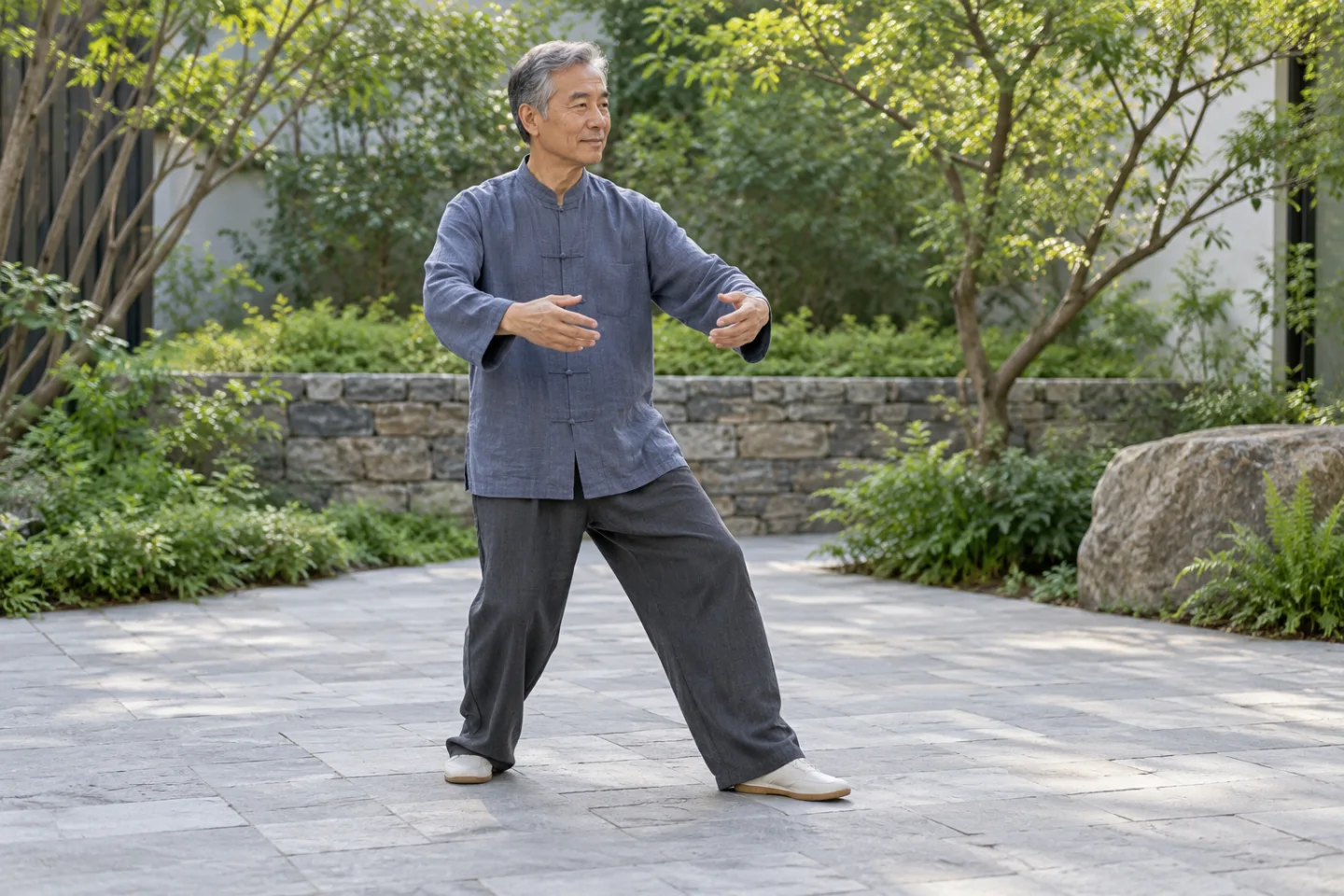
The 24-form was compiled in 1956 using Yang-style material to provide a shorter introduction. You still learn footwork, changes of direction, and transitions. A clear course matters more than trying to finish quickly.
| Feature | Simplified 24-form | Traditional Yang-style forms |
|---|---|---|
| Sequence | 24 numbered movements | Longer sequences; counts vary by tradition |
| One run-through | About five minutes in the cited example | Depends on the sequence and pace |
| Material | A shortened, standardized sequence | More repetition and lineage-specific detail |
| Course choice | Check that the lesson teaches this 24-form | Check the exact routine and teacher’s version |
| First lesson | Opening and a short transition | A short section chosen by the teacher |
These are differences in learning material. A traditional form can also be taught to beginners when the course breaks it down clearly.
KEEPING A PRACTICE
Build familiarity, one return at a time.
A useful early change is being able to repeat a section without chasing the screen. Research on balance and sleep concerns longer, structured programs; it cannot promise what you will feel after a few sessions.
First session
Recognize the opening
Learn where the hands finish and which foot moves. You do not need to remember the whole form.
Over several weeks
Connect familiar sections
Review the transition between two movements as well as each movement on its own.
Over months
Read research in context
Some trials use 12–24 weeks of instructed classes. Their outcomes depend on who took part and what program they followed.
As practice continues
Keep refining
A familiar sequence leaves more attention for coordination and feedback. Longer forms and partner work are separate learning choices.
A SPECIFIC RESEARCH PROGRAM
58%lower fall rate
A 2018 trial followed 670 adults aged 70 or older with high fall risk. After 24 weeks of twice-weekly, 60-minute classes, the adapted tai ji quan group had a 58% lower fall rate than the stretching group. This was a supervised eight-form balance program, not an ordinary 24-form course.
Read the trial and its limitsSLEEP RESEARCH
320older adults with insomnia
A 2021 Hong Kong trial studied adults aged at least 60 with chronic insomnia. The tai chi program taught the Yang-style 24-form in three 60-minute classes weekly for 12 weeks. Compared with no added intervention, actigraphy measured about 13 fewer minutes awake after sleep onset. Objective sleep outcomes did not differ significantly from walking plus strengthening.
Read the sleep studyThings you can notice while learning
Watching every second→Recognizing the next step
Can you recall the next movement without turning toward the screen?
Unclear directions→Knowing where the feet go
Name the travel direction before adding the arm movement.
Everything at once→One detail at a time
Choose one question, such as when the weight moves, for the next review.
Separate movements→A smoother connection
Watch the moment between two familiar positions; it is part of the movement too.
An ambitious schedule→A repeatable practice
Choose a short section you can return to, using the same course.
These are learning observations, not guaranteed health changes. Study results apply to the participants and programs described below.
HOW TO LEARN
Learn a section. Review its connection.
Use one course throughout the first pass. These articles explain the opening and a way to learn in sections; the First Chi tai chi course remains in development.
Understand the task
Use plain descriptions for relaxation, weight distribution, and continuity. Look for each in one movement.
Learn one short section
Watch first, check the direction, then practice the demonstrated section. Use a back view when turns make the front view confusing.
Connect and review
Join the new section to the one before it. Review the join itself, then return to the same teacher for feedback or clarification.
Tai chi course in development
BACKGROUND
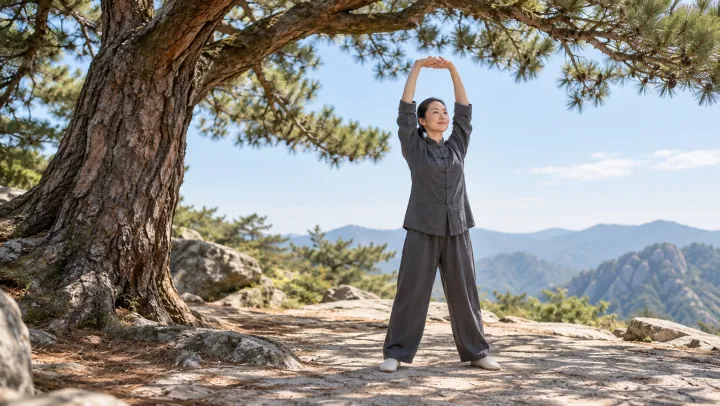
A living tradition, with many forms.
UNESCO describes tai chi as a practice originating in the mid-17th century in Wenxian County, Henan, China. Its cultural account connects coordinated movement with ideas of yin and yang; cultural recognition does not establish a health effect.
Over generations, different teaching traditions developed. A 2019 response from China’s General Administration of Sport lists Chen, Yang, Wu, Wu/Hao, and Sun among the major styles. These names identify traditions, not a single numbered routine.
In 1956, the national sports commission compiled the simplified 24-form from Yang-style material. A 48-form drawing on several styles followed in 1979. This site uses the 24-form as its concrete beginner example.
Tai chi was inscribed on UNESCO’s Representative List of the Intangible Cultural Heritage of Humanity in 2020. A 2025 Chinese Ministry of Education release reports the designation of March 21 as International Taijiquan Day and practice in more than 180 countries and regions. The reach figure is the release’s estimate.
- 1956Compilation of the simplified 24-form
- 2020UNESCO cultural heritage inscription
- 180+countries and regionsReported by China’s Ministry of Education, 2025
Further reading
Explore a question
Read more about learning at home, choosing a style, weight shifts, and building a short practice.
Common questions
Before you begin,
a few useful answers.
Is tai chi hard to learn?
A whole routine can look complicated. Start with the opening and one short section of a named beginner course. The 24-form is a shortened routine, but remembering its sequence and learning its transitions are different tasks.
How long should a beginner practice?
Use a short session to review a movement you have already learned. A complete 24-form takes about five minutes in the cited teaching example; learning and pausing take longer. The hour-long classes in trials are research schedules, not a personal requirement.
What if I am older or have limited mobility?
Check what a class actually asks you to do: stepping backward, turning, bending the knees, and standing on one leg can all matter. Ask whether the teacher offers supported or seated alternatives. Age alone does not tell you whether a particular routine fits.
Do I need to understand the theory before moving?
Learn a few concrete meanings first: relaxation is not collapsing, and weight distribution is not simply where the feet are placed. Then examine these ideas in one movement. You do not need to master a vocabulary before your first lesson.
What should I learn first?
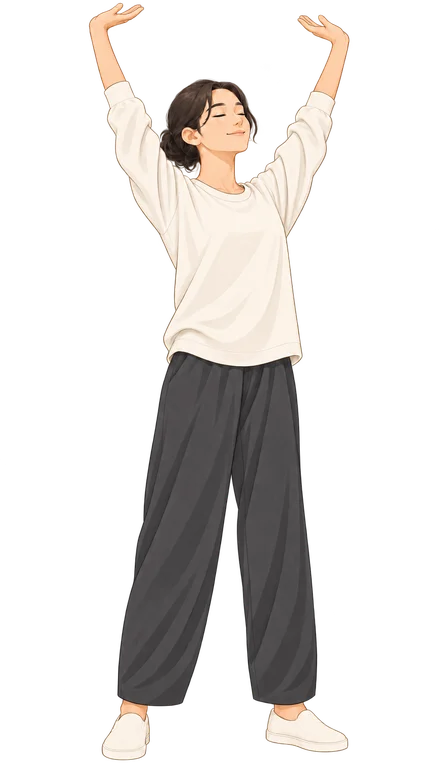
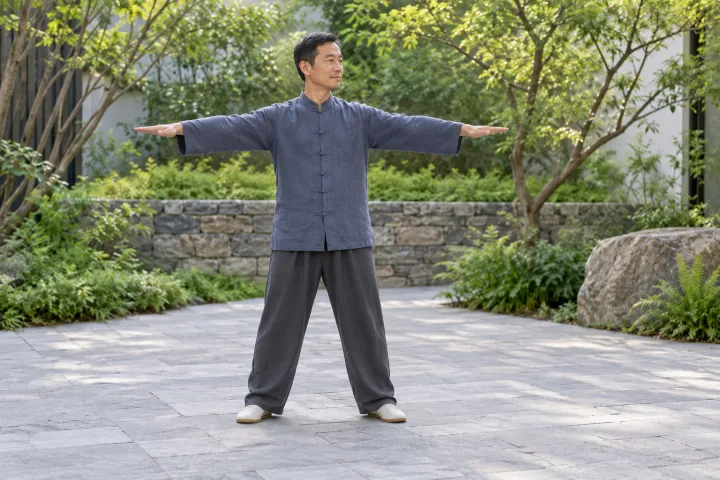
Choose a course that names its routine and shows the feet clearly. Start with Opening: stepping out, raising the arms, then bending the knees and pressing the palms down. Add the first transition only when you can follow its direction.
What is the difference between Yang style, 24-form, and a 28-day course?
Yang is a style. The simplified 24-form is a specific routine. Twenty-eight days describes a course schedule. Record all three separately so that you do not accidentally switch routines while following online lessons.
Why does Single Whip appear twice in the 24-form?
It occupies positions 9 and 11, with Cloud Hands between them. These are two places in the routine, with different preceding movements, not an accidental duplicate in the list.
Does Opening finish in the holding-a-ball position?
No. Opening finishes with the palms facing down near the front of the hips. The upper-and-lower hand arrangement develops during the transition into Part the Wild Horse’s Mane, alongside changes in foot position and weight.
If I have stepped forward, has my weight moved forward too?
Not necessarily. Foot placement and weight distribution are separate. Watch the sequence of drawing in the foot, stepping, and moving into a bow stance. A single fixed weight ratio cannot describe the entire routine.
How do I follow a video when the teacher turns away?
Preview the section without moving. Check its travel direction, then use a back-view or breakdown from the same course. Clear space for forward, backward, and sideways steps. Do not twist toward the screen while continuing a turn.
Should I start with tai chi or Baduanjin?
To learn stepping, turning, and a connected form, compare named tai chi beginner courses. To study eight main movement groups separately, explore standing Baduanjin. Check the actual teaching, physical demands, and feedback available; a slow demonstration alone cannot determine suitability.
Read the sources
Historical details are attributed to institutional sources. Research summaries name the participants and program, with limits on what the findings show.Updated .
Begin with Opening.
Step out, raise the hands, then bend the knees and press the palms down. Read the sequence before adding the next movement.
Tai chi course in development
Explore the app courses: Baduanjin · Jingang Gong