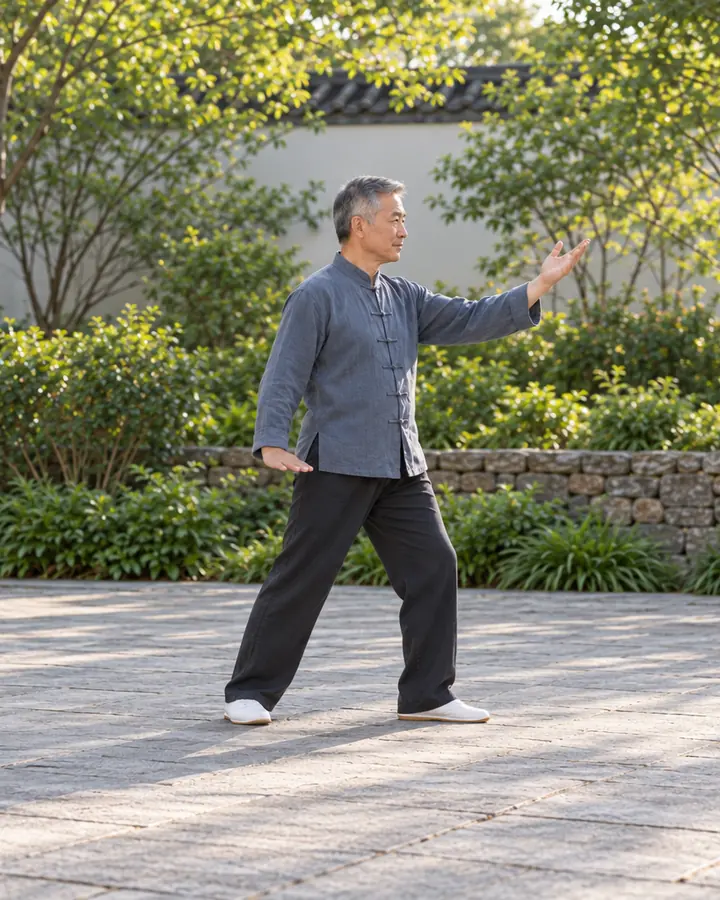
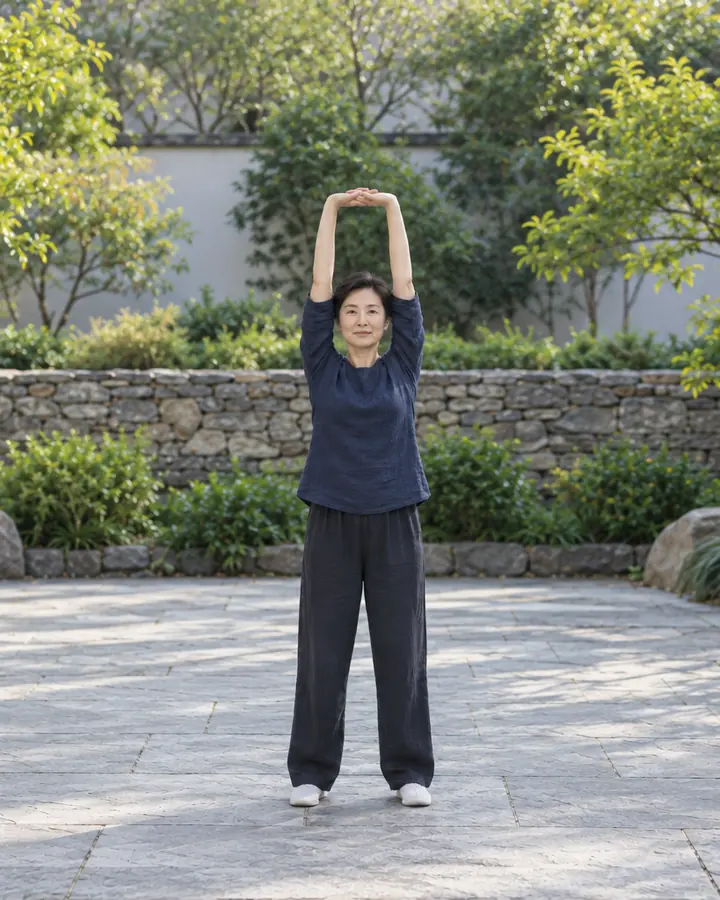
Baduanjin has fewer main movements to remember; the 24-form offers a longer connected stepping sequence. Choose by the skill you want to learn and how clearly the course teaches it. Fewer movements does not automatically mean less physical demand.
Why tai chi also appears in qigong searches
In the context of health practice, NCCIH describes tai chi as a form of qigong with a martial background. Tai chi also has distinct styles, forms, and training methods. Qigong includes many practices beyond Baduanjin.
For a useful beginner comparison, this article uses the 24-form and standing Health Qigong Baduanjin (Eight Pieces of Brocade). It does not treat all tai chi and all qigong as two identical, fixed routines.
What would you actually learn?
| Question | 24-form tai chi | Health Qigong Baduanjin |
|---|---|---|
| Sequence | 24 connected forms with forward steps, backward steps, and turns | Eight main movement groups with preparation, closing, and side changes |
| Easy to miss | Drawing in a foot, stepping, and shifting weight while watching the hands | Entering, changing sides, and returning while watching a final pose |
| Teaching to check | Basic footwork, individual forms, and connections | A named version, individual movements, and staged breathing instruction |
| Movement demands | Turns, backward steps, low positions, kicks, and one-leg stances | Reaches, knee bends, swaying, forward bends, and heel raises |
Baduanjin has a shorter sequence to learn, but still needs coordination. Tai chi can also be learnt in small sections. The movement count does not establish one learning deadline or exercise load for everyone.
Slow and gentle are not enough to judge suitability
Look at the actual movements. A standing Baduanjin bend and a 24-form backward step or one-leg stance make different demands. Versions and teaching methods matter too.
Describe any difficulty precisely, such as losing support after a turn or pain while bending. Discuss appropriate instruction or adaptations. Fewer movements or a small practice area does not by itself establish suitability for a person’s health circumstances.
Match a first lesson to what you want to learn
Here are two concrete starting points in this site’s teaching material:
- To learn connected stepping: inspect the 24-form opening and first step. Locate drawing in the foot, placing the next step and transferring support. If you can see the hands but cannot explain when support changes, choose a footwork breakdown before a full follow-along.
- To learn a repeated movement in a set stance: inspect the Baduanjin opening and first lift. After the initial side step, the feet stay in place during repetitions. Locate interlacing, the overhead palm turn and the palms-up return. If the return is unclear, review it before matching the count.
For example, a beginner who wants a short sequence to remember could start by reviewing Baduanjin’s first lift. Someone specifically interested in moving from step to step could start with the tai chi unit. These are learning choices, not fitness rankings. If the preferred course leaves those transitions unexplained, seek a clearer lesson or teacher feedback before choosing the full routine.
Keep health comparisons separate from lesson choice
The 2018 falls trial studied an adapted tai chi programme against other exercise groups, with no Baduanjin group. It cannot establish which of these two beginner courses is better. For a health question, check the actual programme, participants and outcome; for today’s lesson choice, use the sequence and instruction above.
References and sources
- NCCIH: Qigong—What You Need To Know
Explains the overlap when tai chi is practiced for health. This context does not make all martial training identical or transfer findings from one routine to another. Read our study summary →
- Tsinghua University staff tai chi association: names of the 24-form movements
Downloaded and converted the Word document in this English review. Compiled in June 2003, it lists the 24 movements and component actions. It does not prescribe a universal step length, stance depth, or practice dose.
- Chinese Health Qigong Association: Health Qigong Baduanjin and traditional Baduanjin
The December 14, 2018 article explains retaining eight movements and arranging preparation, closing, and transitions. Used to compare learning material, not health effects.
- Li F et al. (2018): therapeutic tai ji quan and falls in older adults
JAMA Internal Medicine, doi:10.1001/jamainternmed.2018.3915. Read the open paper: 670 adults aged 70 or older with prior falls or impaired mobility; 24 weeks, two 60-minute classes weekly. The adapted balance program was compared with multimodal exercise and stretching, not ordinary 24-form versus Baduanjin. Read our study summary →
- NCCIH: Tai Chi—What You Need To Know
An overview of research, safety, and variation in instructor training. It does not validate every tai chi course, and trial schedules are not personal practice prescriptions. Read our study summary →