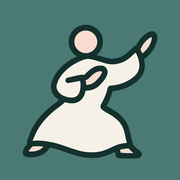
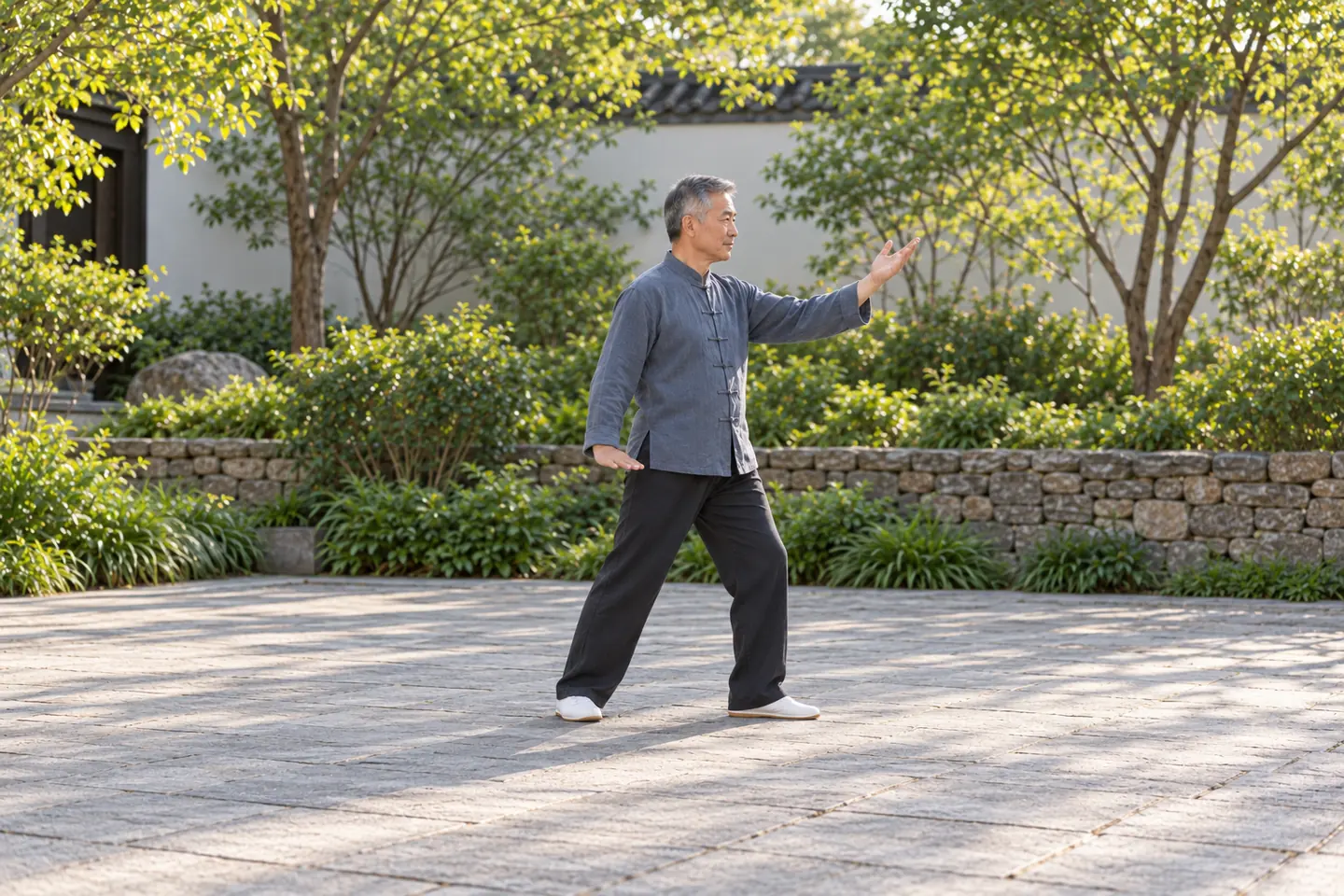
Opening steps the left foot sideways, raises both arms forward, then bends the knees while pressing the palms down. To begin left Parting the Wild Horse’s Mane, draw in the left foot with right-side support, step forward-left, then gradually form the bow stance.
Check the version, directions, and demonstration segment
This guide covers Opening (Qi Shi) and the first left Parting the Wild Horse’s Mane (Ye Ma Fen Zong) in the simplified 24-form. It follows the same Shandong Engineering Vocational Technical University teaching series for Opening and Parting the Wild Horse’s Mane, with the Tsinghua list used for sequence checks. It does not describe every Yang-style or other opening.
Directions mean your own left and right. The original lessons include front and rear views, breakdowns, and common-error segments. An error demonstration must be read with its explanation. Observe the whole body and feet before following; stop with pain, dizziness, or obvious instability.
Opening, first phase: step the left foot sideways
- Stand ready: face forward, arms hanging naturally at the sides, looking ahead. This is not yet the holding-a-ball position.
- Shift support and step left: first support the body on the right, then move the left foot sideways. Once it settles, the feet are roughly parallel and shoulder-width apart.
- Settle before raising the hands: this is a side step, not a forward bow stance. Do not throw the body left while opening the foot.
The source calls this opening the feet. Shoulder width is a guide, not a centimetre measurement everyone must copy. If the step or standing position is unstable, obtain guidance before adding arm changes.
Opening, phases two and three: raise, then bend and press
- Raise both arms forward: move the hands from the sides up in front, palms down and fingers forward, to about shoulder height. They travel forward, not sideways around to the head.
- Lower elbows and press palms: gradually lower the elbows and press the palms down while bending both knees. Keep the trunk upright rather than bending forward to lower the hands.
- Finish near the front of the hips: hands remain in front, palms down, with feet apart. The hands are not yet facing each other in a holding-a-ball shape.
Watch how lowering the hands and body belong to the same phase. Do not copy another person’s knee depth, hold the breath to support the movement, or force joints locked straight. The text does not establish an individual range of motion.
Hold the ball and draw in the left foot
After Opening, turn slightly right and gradually bring more support onto the right side. Move the right hand near the right chest, palm down. Bring the left hand underneath, palm up, so the palms face each other vertically.
At the same time, draw the left foot inside the right foot with its toe lightly touching the ground. The body remains mainly supported on the right; two feet touching does not mean equal weight-bearing. The upper-and-lower hand shape differs from the two downward palms at the end of Opening.
Step first, then gradually form the left bow stance
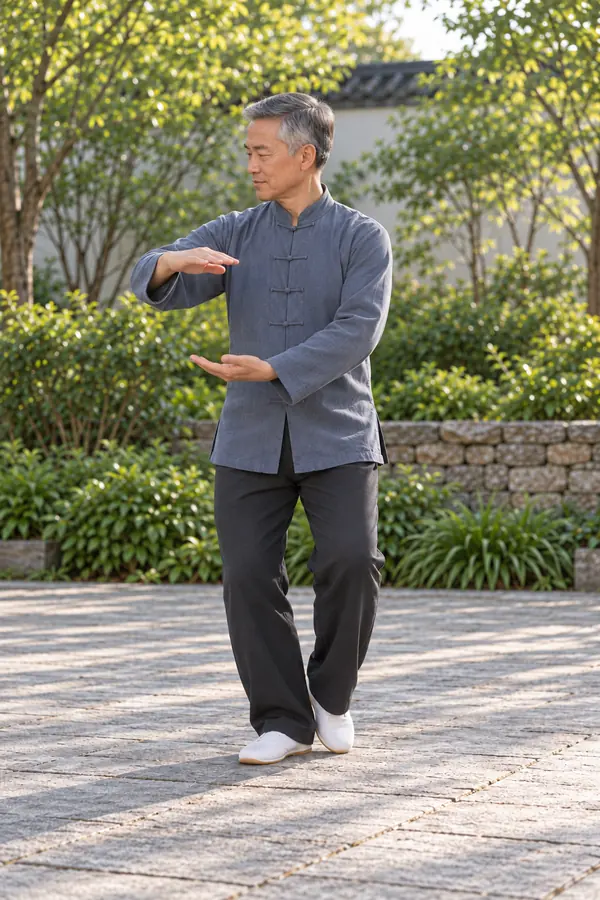 Left foot drawn in, toes touching
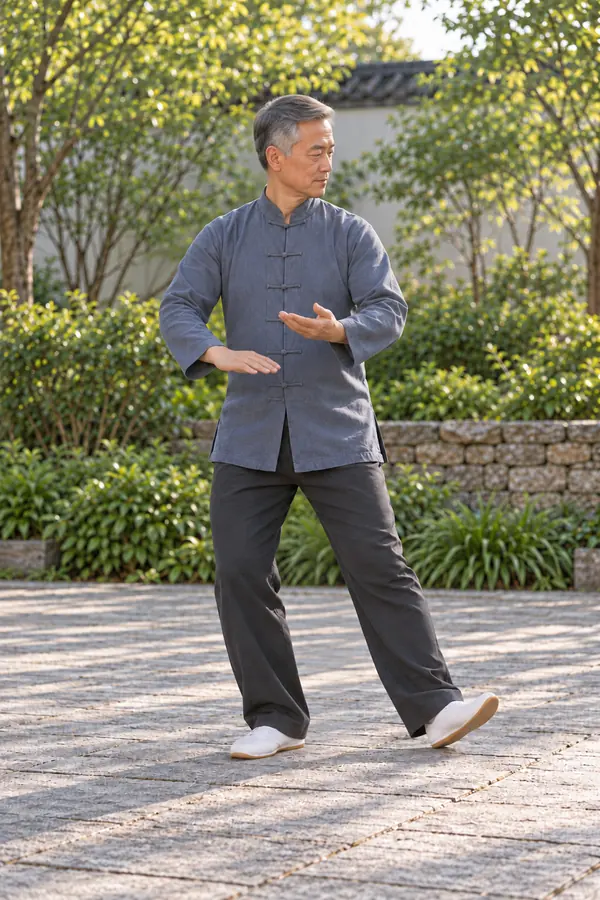 Left heel touches down first
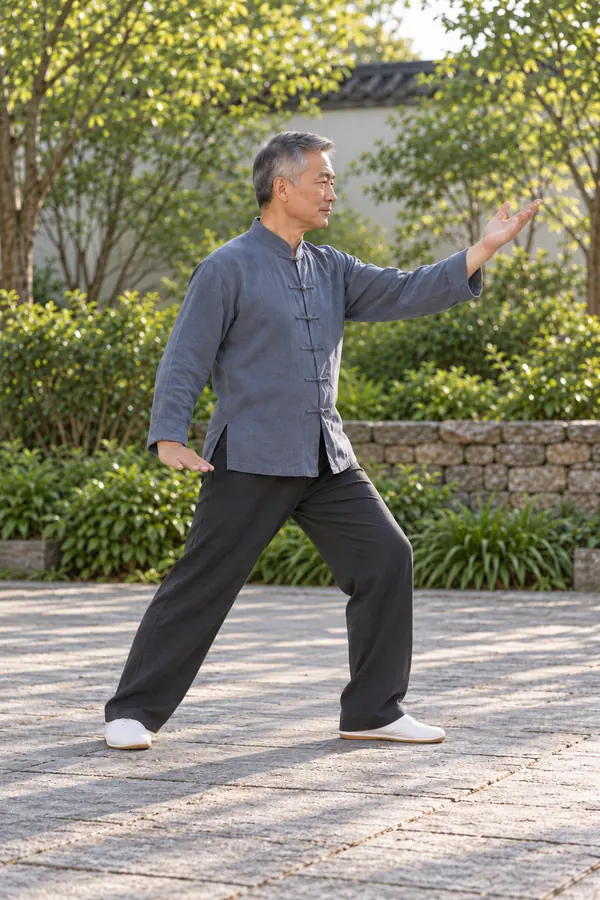 Weight moves forward into the bow stance
- Step the left foot forward-left: from the drawn-in foot and holding-a-ball position, turn and step diagonally forward-left, touching the heel down lightly first. Do not rush the body forward before the foot settles.
- Gradually transfer support: as the left sole settles, move the body forward, bending the left leg and extending the right into a left bow stance. The foot arriving and the body moving onto it are distinct moments.
- Separate the hands: the left hand opens forward-left and upward, palm diagonally up; the right presses beside the right hip, palm down. Read this with the turn and forming stance, not as a final hand shape with footwork added afterward.
This describes the first left-side sequence only. The next side also needs shifting back, turning, and drawing in a foot. Continue with the same lesson in our left-right-left side-change breakdown; swapping the hands alone does not complete the right side.
Three stages: feet, support, and palms
| Stage | Feet and support | Palms |
|---|---|---|
| End of Opening | Feet apart, knees bent, before the forward bow stance | Hands near the front of the hips, palms down |
| Hold the ball, left foot drawn in | Main support on the right; left toe lightly touches inside the right foot | Right hand above facing down; left below facing up |
| Left step into bow stance | Left foot settles before support gradually moves forward | Left palm opens diagonally upward; right presses down beside the hip |
The table identifies phases without assigning a fixed weight percentage. See stances and support if the terms remain unclear; do not twist a supporting foot while guessing a ratio.
Check the connection before adding the next movement
Can you distinguish the end of Opening from holding the ball? Which side supports you when the left foot draws in? When the heel first touches, are you already rushing weight onto the front leg? These questions locate a problem; they cannot replace someone observing your movement.
Compare the original front and rear views, keeping common-error demonstrations with their explanations. Continue to learning the form in sections and use the 24-form list to locate neighbours.
References and sources
- Shandong University of Engineering and Vocational Technology: 24-form Opening lesson
Physical education teaching page, September 6, 2025. This English pass opened the hosting page; the movement account retains the October 17, 2026 Chinese editorial review of front, back, and breakdown views. No new full video or audio review is claimed. The page does not name the instructor.
- Shandong University of Engineering and Vocational Technology: Part the Wild Horse’s Mane
Hosting page reopened in this English pass. The movement sequence retains the October 17, 2026 visual review of drawing in the foot, stepping, shifting weight, and separating the hands. Error demonstrations are not presented as correct positions. No universal angle or weight ratio is inferred. The new side-change article separately records its October 20 video-range review; the older record is not relabelled as a full-video audit.
- Tsinghua University staff tai chi association: names of the 24-form movements
Downloaded and converted the Word document in this English review. Compiled in June 2003, it lists the 24 movements and component actions. It does not prescribe a universal step length, stance depth, or practice dose.
- NCCIH: Tai Chi—What You Need To Know
An overview of research, safety, and variation in instructor training. It does not validate every tai chi course, and trial schedules are not personal practice prescriptions. Read our study summary →