Your first qigong practice
New to qigong?
Eight questions to start with
Learn about home practice, choosing a routine, time, qi and following videos. Start with the question on your mind.
Jump to a question
- 01Can I learn qigong at home?
- 02Which routine and version should I choose?
- 03How long should I practise? What can I expect?
- 04Do I need to believe in qi?
- 05What about age or knee problems?
- 06What if practice feels uncomfortable?
- 07What if a video reverses left and right?
- 08Where can I start learning?
01Learning at home
Can I learn qigong at home?
Start with the basic sequence.
Baduanjin and Jingang Gong each have eight main parts, plus opening and closing. You can study them in a small space without a partner, but they include steps, turns and forward bends. For example, Jingang Gong part two steps forward and draws the foot back. Allow room for those changes. Keep three things in mind:
Stay with one version
Teachers may teach different details within the same routine. Switching between them can make those details harder to understand.
Learn a movement before linking it
Work on one movement at a time. Understand where your feet stand and where your hands go. Once you know the parts, link them with spoken cues.
Do not push through discomfort
You do not have to match the demonstrator's full range of movement.
A teacher can offer feedback a recording cannot. For self-study, you can record your movements on your phone and compare the visible positions with the demonstration.
02Choosing a routine
Which routine and version should I choose?
Choose instruction that shows the feet, starting position and finish clearly. Staying with one version makes it easier to identify the part you have not understood; it does not require committing to a fixed number of months or years.
If you are undecided, compare the first movement of each. Look at the footwork, arm path and clarity of instruction. Baduanjin emphasises stretching and Jingang Gong deliberate effort; a name alone cannot establish suitability.〔1〕〔2〕
| Feature | Baduanjin | Jingang Gong |
|---|---|---|
| Movements | Eight movements with changes of stance, head turns and forward bends | Eight parts with several steps; repetition units differ by part |
| How it works | Learn in sections, including the opening and closing | Start with preparation and part one; continue when you understand the changes |
| First Chi guided routine | About 30 minutes | About 20 minutes |
| Breathing | Natural breathing | Natural breathing without memorising breath timing |
| What to check first | The first movement’s arm path and opening steps | The first part’s hand shapes and transitions |
These times describe First Chi guided courses, not every version or a daily exercise prescription. Jingang Gong parts two to five count both sides as one repetition; part eight counts five heel rises and lowers as a section. See learning and repetition counts. For tai chi footwork and connections, explore our tai chi beginner guide.
03Practice time
How long should I practise? What can I expect?
Separate time spent learning from time spent moving. Studying the opening and first movement in one session is a learning example, not a daily prescription. Pausing, reviewing and following a routine take different amounts of time. Also separate personal observations from research outcomes:
After a session
Notice how you feel
You may notice warmth, less tension or a quieter moment. You may also notice no particular change.
With repeated practice
The sequence becomes familiar
You may need fewer reminders and find it easier to follow the spoken cues through a routine.
Over weeks or months
Studies measure specific outcomes
A 2017 review included programmes lasting 4–24 weeks. Pooled sleep and quality-of-life results favoured Baduanjin, with differences in populations, controls and trial quality. Inconsistent confidence-interval and significance reporting prevents presenting the balance result as a clear benefit.〔3〕
There is no deadline for feeling a result. A useful personal observation is: how do you feel before and after a session? Record whether the instructions were clear and whether anything felt uncomfortable, too. One relaxing session is not enough to decide what to continue; see reviewing and adjusting your practice.
04About qi
Do I need to believe in qi?
No belief is required.
Qigong combines posture and movement, breathing and attention. NCCIH, part of the US National Institutes of Health, describes those elements in its introduction.〔4〕 You can work with movement and breathing without adopting a belief about qi.
Some practitioners describe warm or tingling palms. Such sensations are not required and do not show whether you are doing a movement correctly. Trying to produce a feeling can distract you from the instructions. Pause or adjust if tingling occurs; persistent or recurring symptoms need separate assessment.
The lessons do not require a religious commitment. Baduanjin is taught as a movement practice. Jingang Gong has a Daoist teaching background, while these lessons focus on movement and breathing.
05Your starting point
What if I am older, have knee problems or have been inactive?
Check the specific movements and your circumstances.
People of different ages practise qigong. These routines move slowly, without running or jumping, but that does not make every standing movement suitable for everyone. A website cannot assess an injury or your individual exercise needs.
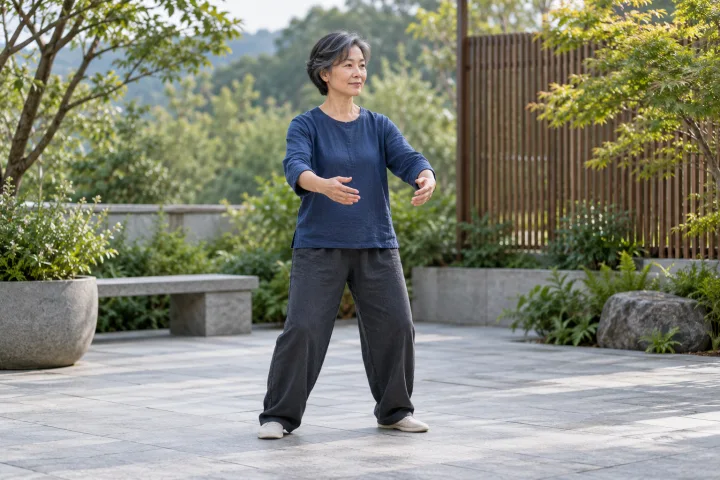
Read the knee-position instructions
- In a bent-knee stance, the knees follow the direction of the toes rather than turning inward.
- A demonstrator's stance depth is not a target to force your body into.
- The standing instructions use soft knees rather than locked legs.
If standing practice is not what you are looking for, explore seated qigong.
NCCIH advises people with health conditions to discuss suitability with a health professional. That is separate from learning the sequence on a website.〔4〕
06Discomfort
What if practice feels uncomfortable?
A sensation is not proof that a practice is working. Do not use this page to diagnose symptoms.
Sensations people describe
Practitioners sometimes describe warmth, light sweating, yawning or tired muscles. A description from another person cannot establish whether your own symptoms are harmless. Pause or adjust for tingling, soreness or unstable support; persistent or recurring symptoms need separate assessment.
Do not push through pain
Joint pain, especially around the knees or lower back, is not a learning target. Dizziness, chest discomfort, palpitations or difficulty breathing are reasons to stop practice and seek appropriate medical guidance, rather than trying to finish the routine.
These beginner lessons use natural breathing. They do not ask you to hold your breath or force unusually deep breaths. Learn the movement path before adding any breath-timing instructions from your chosen version.
Practice should not require pushing through emotional distress. Pause and seek appropriate support if needed.
07Following a video
What if a video reverses left and right?
Check whether the view is front-facing, rear-facing or mirrored. Without mirroring, a teacher facing you has their left hand on the right of your screen.
The written directions use your own left and right. Jingang Gong Part 2 starts with the left foot; do not swap the starting side or skip the return step because both sides are practised. If unclear, pause for the screen and direction guide.
08Finding lessons
Where can I start learning?
You can read the illustrated guides and articles here without registering.
First Chi's app courses divide Baduanjin and Jingang Gong into lessons, starting with preparation. Guided routines use spoken cues, and practice records count your days. Under the current course plan, introductions, preparation and the first three parts or movements are free; later lessons and complete guided routines require a subscription. The app is not yet available to download; begin with the website articles.
References and sources
Sources support specific statements, not promises about a practice. This page was revised on 2026-10-20 against the site’s checked sources; this edit does not represent a fresh reading of every external source. See our Editorial policy.
- Chinese Health Qigong Association: How does Health Qigong Baduanjin relate to traditional Baduanjin?
Published 2018-12-14. Used for the arrangement of eight movements, opening and closing; its health claims are not adopted here.
- Jingang Gong: original book and illustration sources
Used for the eight parts, individual steps, preparation and closing. Repetitions, rounds and sections mean different things in different parts; this is not a single five-repetition rule for every part.
- Baduanjin health review, 2017: study summary
Included 19 randomised trials with 1,535 adults and programmes lasting 4–24 weeks. Sleep: six trials, 597 people; quality of life: six trials, 611 people. Balance reporting contains inconsistent interval and significance statements. Trial quality and adverse-event reporting limit what can be concluded about personal outcomes.
- NCCIH: Qigong: What You Need To Know
Institutional information about posture, movement, breathing, attention and health-related precautions. It is not evidence for the effects of a particular course.
Choose one routine.
Begin with the first lesson.
Each routine has a beginner guide to help you find a starting point.
Learn the steps. Follow the cues. Keep a record.
 Not yet available
 Not yet available