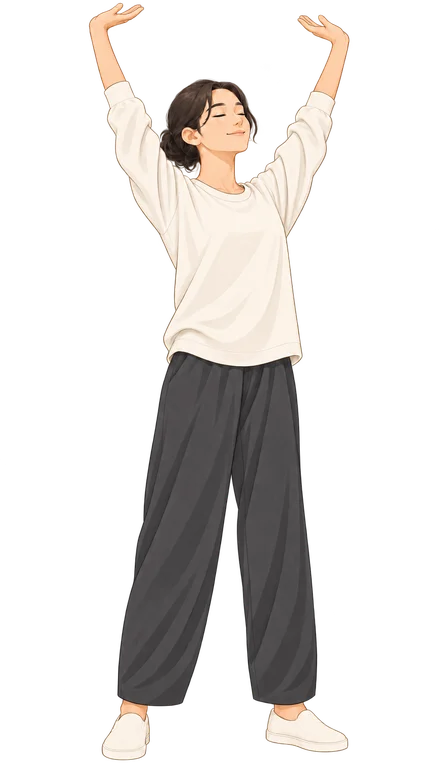
Jingang Gong · Eight parts
Learn Jingang Gong,
one part at a time.
Learn preparation, eight main parts, and closing through smaller steps. Counting units differ between parts. Understand the current palm directions, foot positions, and return before connecting the routine.
- 8 partsEach includes internal changes
- BreatheNaturally, without a count
- About 20 minFor the First Chi guided arrangement
- StandingIncludes steps and turns; no equipment
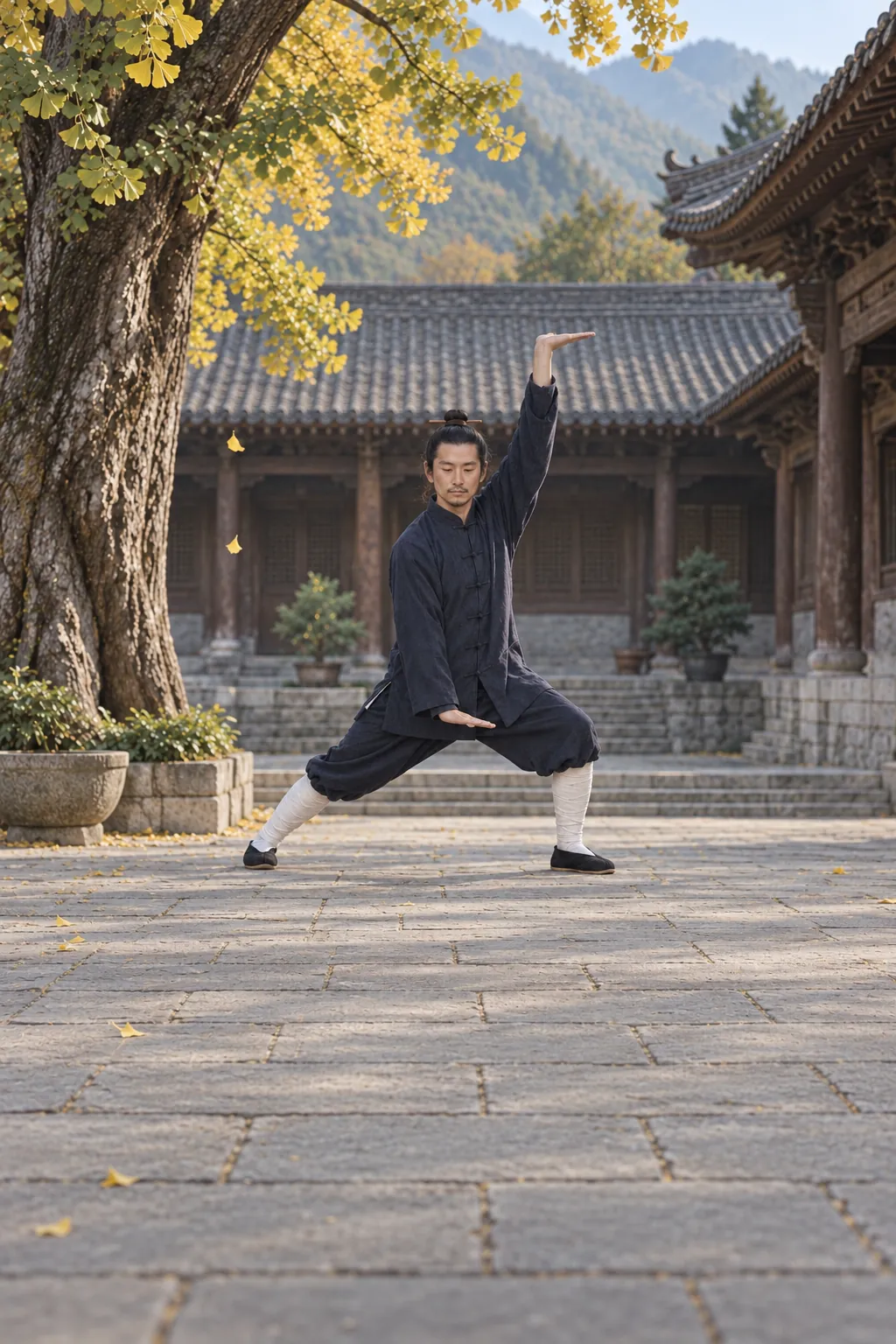
Compared with tai chi
Eight parts, with changes to learn within each.
Both Jingang Gong and 24-form tai chi can be learned in sections. Jingang Gong uses a relatively small area, but still includes stepping out and in, turns, and bends. Each part also has hand shapes, palm directions, and connections to learn. Counting names alone cannot establish difficulty or how long an individual will take to learn.
| Feature | Jingang Gong | 24-form tai chi |
|---|---|---|
| Sequence | Eight main parts, with different counting units | 24 connected forms |
| Breathing | Follow the source’s natural breathing; do not add breath holds | Coordination develops as the form becomes familiar |
| Footwork | Uses a small area, with steps and turns within parts | A route with steps, turns, and weight shifts |
| Space | Room for the full arm, step, and bend range | Also needs room for the form’s stepping route |
| Remembering | Learn eight parts and their internal changes | Learn the route, directions, and connections |
This compares learning tasks in Jingang Gong and 24-form tai chi. Counts of names do not establish difficulty, learning time, or health outcomes.
Building a regular practice
A familiar sequence to return to each day.
Regular practitioners describe feeling more alert, less stiff, or more settled. These are personal accounts, not a schedule of effects everyone can expect. The practical starting point is learning a routine you can return to.
After a session
Feeling more awake
Some people describe feeling refreshed after the sequence’s efforts and pauses. Others may feel differently.
Over several weeks
Noticing daily energy
Practitioner accounts sometimes mention energy or appetite. These reports do not establish a cause or a promised timescale.
Over several months
Noticing less stiffness
Some longer-term accounts mention less tension after sitting or changes in sleep. These are anecdotes, not trial findings.
Over time
Keeping a manageable habit
The routine needs no equipment. Returning to a familiar sequence can make the habit easier to organise.
Research context
This site has not established a specific clinical benefit for Jingang Gong. The experiences described here are practitioner accounts. NCCIH’s overview explains the broader qigong evidence and safety context.
Read the NCCIH qigong overviewWhat some regular practitioners describe
Feeling tired→Reports of more energy
Some practitioners describe feeling more alert in everyday life; this is not a guaranteed effect.
Stiff after sitting→Reports of feeling less tight
The routine includes reaches and bends. Some accounts describe changes in how the shoulders and back feel.
Posture feels unfamiliar→More attention to standing
The instructions repeatedly draw attention to the trunk and head position; people may become more aware of their stance.
Looking for visible change→Keep personal impressions separate
Some accounts mention appearance. Such impressions cannot establish a health effect or measure technique.
A busy mind→A concrete task to follow
Following hand directions and movement order gives attention something specific to do. Some people describe feeling more settled afterward.
These are individual experiences, not measured or guaranteed outcomes. Existing health concerns need appropriate professional advice.
How to learn
Pause at a step. Understand it. Then continue.
Zhang Zhishun’s demonstrations preserve the sequence, but the pace and spoken language can be difficult for a new learner. First Chi separates each part into smaller steps. Current course explanations are in Mandarin; the English website helps you identify the sequence and positions.
Learn one part
Use the step diagrams, explanations, and demonstration video. Move on after the current transition is clear.
Follow the full sequence
Once you know all eight parts, connect preparation, the parts, and closing with spoken cues. A full routine takes about 20 minutes.
Build 100 practice days
Count cumulative practice days. A break does not erase the days already completed; return and continue.
App coming soon · iOS / Android
Background and sources
The teaching materials associated with Zhang Zhishun.
Jingang Gong is taught in a Daoist context. The manual describes an earlier lineage passed from teacher to student. That is a transmission account, not a separately verified historical timeline.
Zhang Zhishun, also known as Mi Jing Zi, demonstrated and explained the practice in his later years. His name appears in both the manual and illustrated material used for this topic.
The manual Babu Jingang Gong and the illustrated guide provide numbered actions, teaching details, and repetition instructions. First Chi’s movement articles use these two sources to keep the sequence consistent.
Practitioner discussions can explain why people choose the practice and what they find difficult. Their popularity and personal reports do not establish health effects. For learning, compare the actual part numbers and transitions.
- 8partsPlus preparation and closing
- 147pagesIn the manual scan used for reference
- 33pagesIn the illustrated movement guide
Further reading
Keep reading
Find an answer about breathing, effort, review, home practice, or choosing teaching materials when you need it.
For the names and order of all eight parts, see《Jingang Gong: Eight Movement Names and Their Sequence》。
Common questions
Before you begin,
a few common questions.
Can I start if I have never practised before?
Begin by learning a small section and checking what its movements require. The sequence includes standing, bends, turns, and heel raises. Choose an amount and range appropriate to your circumstances; ask a qualified professional about participation when health conditions affect you.
How long does a session take?
A full guided routine takes about 20 minutes, depending on pace and repetitions. The First Chi full-routine arrangement uses that approximate length. Learning can focus on one part or transition; there is no requirement to learn a part each day or finish in a fixed number of days.
Which article should I read first?
Read the beginner guide, then preparation and Part 1. First identify the starting position, palm directions, and return sequence. Pause to check an unclear transition instead of racing through all eight parts.
Is Jingang Gong the same as Baduanjin?
No. Both have eight main parts, but their sequences and hand shapes differ. Jingang Gong Part 1 includes a sideways arm raise, upright palms, and changes above the head. Baduanjin’s first movement cannot replace those instructions.
Why learn preparation and closing as well as the eight parts?
Preparation connects feet-together standing with stepping out and bringing the hands in front of the abdomen. Closing follows Part 8. Returning the hands to the abdomen within a part is not the same as closing the complete routine.
How do the nine steps of Part 1 relate to the eight parts?
The eight parts make up the main routine. The nine steps are the internal breakdown of Part 1, numbered 1-1 to 1-9 in the manual. They are not nine walking steps or the whole routine.
Do I need to hold my breath or tense my whole body?
The illustrated preparation instructions say to breathe normally. A brief movement pause is not a breath-holding command, and descriptions of effort are specific to each action. Do not add a breath-holding pattern or fixed force percentage.
Do left and right count as one repetition or two?
The manual counts the two sides together for Parts 2–5. Part 6 combines left and right turns into a round. Part 8 uses five heel raises and lowers as a section. Check the part and counting unit together.
Should I finish if a movement hurts?
Pain, dizziness, and obvious discomfort are not milestones to push through or proof of a cleansing process. Stop the current practice and seek appropriate advice for health concerns. NCCIH advises against using qigong to delay medical care.
Read the sources
The manual and illustrated guide support the movement descriptions. Practitioner accounts describe individual experiences; they do not establish clinical benefits.Updated .
Start with preparation today.
Read the Part 1 illustrated guide while the App is being prepared for launch.

Learn the steps. Follow the cues. Keep a record.
 Not yet available
 Not yet available