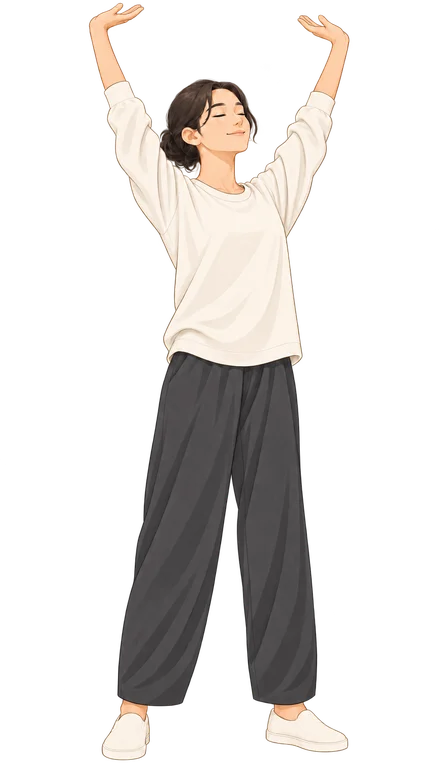
Regular practice · Over time
A little practice,
part of your day.
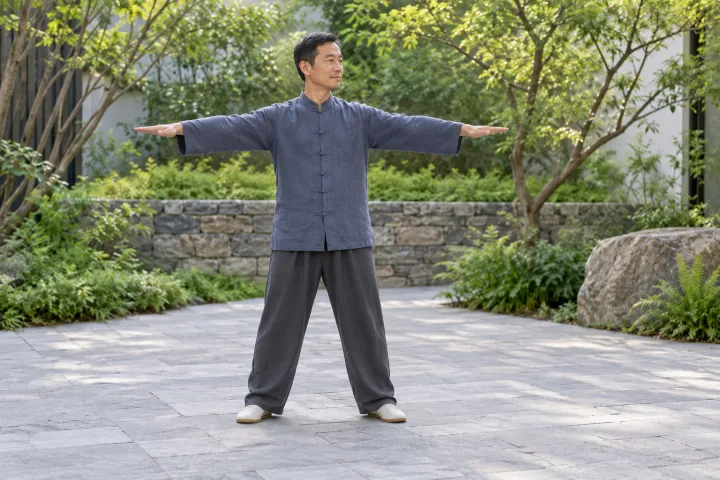
Regular practice makes movements more familiar. Practitioners often describe feeling looser or calmer; studies examine specific changes over weeks or months.
- 15 minutesA short slot to begin learning
- A few weeksTime to become more familiar
- No equipmentFor the standing routines here
- Older learnersIncluded in several studies

WHAT CHANGES
Learning and change take time.
Experiences vary. These are stages people describe, not a timetable everyone must follow.
After a session
A chance to settle
Some practitioners notice warmth, easier shoulders, or a quieter moment.
After several weeks
More familiar movements
You may need fewer pauses and less help remembering the sequence.
After several months
Changes measured in studies
Many research courses run for 12 weeks to six months. Some report improvements in balance, flexibility, or sleep compared with controls.
Continuing over time
A place in everyday life
Standing routines need little space or equipment. In one tai chi study, many participants were still practicing at a two-year follow-up.
PRACTITIONER EXPERIENCES
What regular practitioners describe.
These are personal accounts commonly shared by practitioners, not findings from a controlled study.
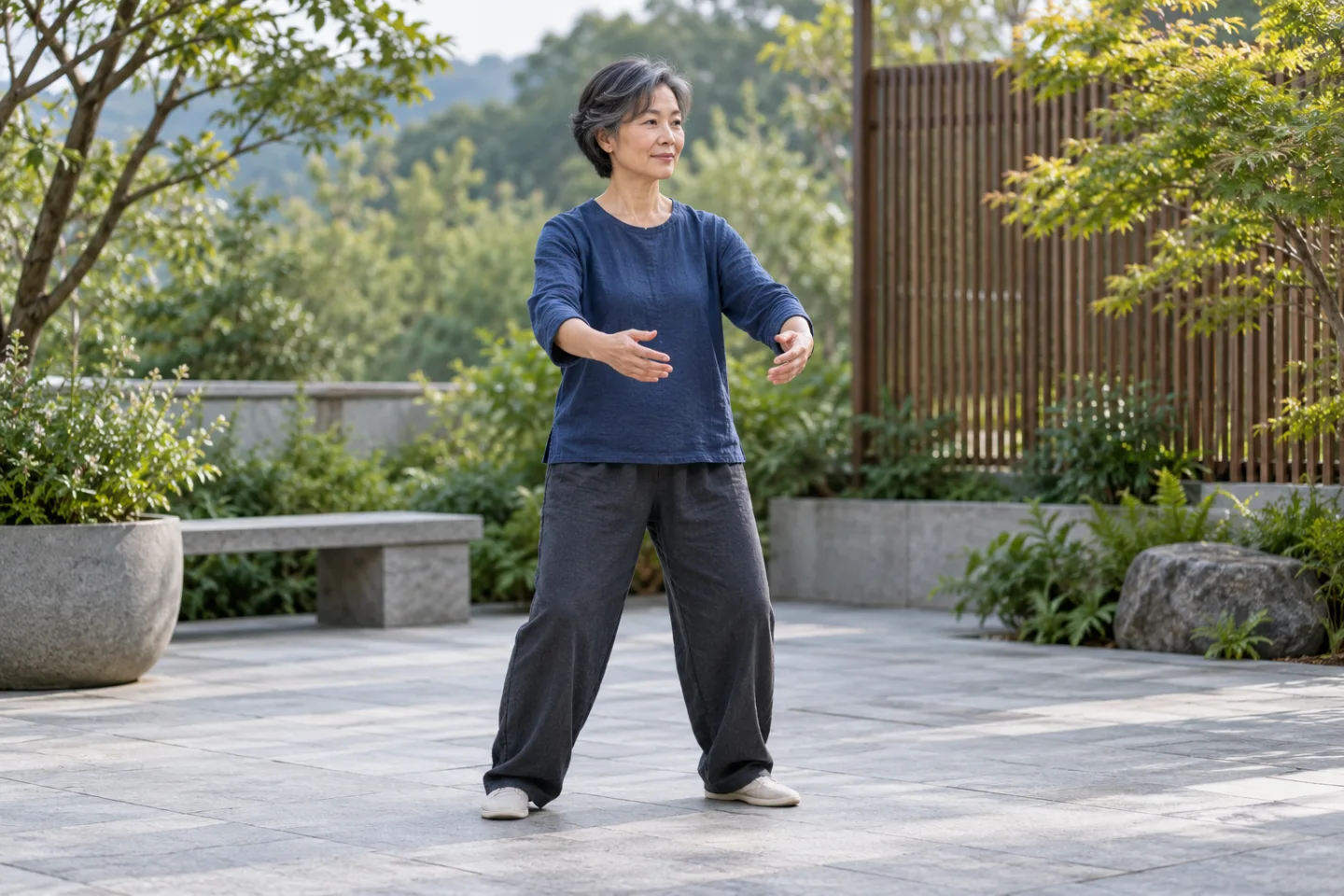
Feeling wound up→A quieter moment
Slower movement gives attention a task and a pause from other demands.
Feeling low on energy→Feeling more awake
Some describe warmth and a sense of energy after a manageable session.
Stiffness after sitting→Easier shoulders and back
Raising the arms, turning, and bending provide a change from a fixed position.
Feeling unsteady→More confidence in standing
Bent-knee positions and weight shifts give balance and leg control a task.
Slumped posture→More awareness of standing
Attention to the head and back during practice can carry into ordinary standing.
Experiences differ. These accounts do not establish a health effect. Ask about suitable activity if you have an injury or health condition.
RESEARCH
What controlled studies have measured.
These three studies describe particular courses and populations. Tai chi has the largest research base of the practices here, followed by Baduanjin. Evidence on Jingang Gong remains sparse.
BADUANJIN · 2017 REVIEW
19randomized trials
The review included 1,535 adults in courses lasting 4–24 weeks. Separate sleep and quality-of-life analyses reported favourable findings, with different samples and limitations in the included trials.〔1〕
Read the reviewTAI CHI · SLEEP · 2021
2years after the course
The trial enrolled 320 adults aged 60 or older with chronic insomnia. After 12 weeks of classes three times weekly, a two-year follow-up found about 27 fewer minutes awake during the night versus control. Some participants kept practicing.〔2〕
Read the sleep findingsTAI CHI · FALLS · 2018
670older adults
Adults aged 70 or older at high fall risk attended two classes weekly for 24 weeks. An adapted eight-form program had a 58% lower fall rate than stretching; this does not describe every tai chi course.〔3〕
Read the trial
These are group averages, not a promise of the same result for every person or a substitute for care. Persistent sleep, joint, or other health concerns need their own assessment.〔4〕
KEEPING A ROUTINE
The useful routine is one you return to.
Experienced practitioners often give beginners these practical suggestions.
No special feeling after a few weeks is a common concern. Notice whether the session feels manageable and leaves you more settled. Read how to review practice when you feel no change.
Six suggestions from regular practitioners
- A short, regular slot is often easier to sustain than an occasional long session.
- Choose a familiar time, such as after getting up or after your evening meal.
- Stay with one routine and version while learning it.
- Do not chase heat or tingling. Notice how you feel and function afterward.
- A few missed days do not erase what you learned. Return without making up a debt.
- Stop for joint pain or dizziness rather than pushing through to finish.
100 PRACTICE DAYS
Give yourself a hundred practice days.
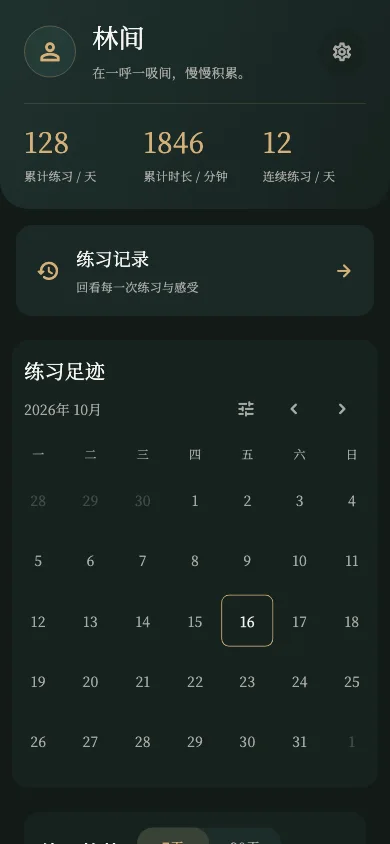
In First Chi, each routine added to your home screen has its own practice-day record. Days count when you practice; they do not need to be consecutive, and a break does not reset the count.
Baduanjin · 100 practice days
Day 37
37 / 100 practice days
- LearnedComplete every lesson
- FlowFollow the full routine 7 times
- 100 daysReach 100 practice days
Sample data. Each routine has its own count, based only on practice within that routine.

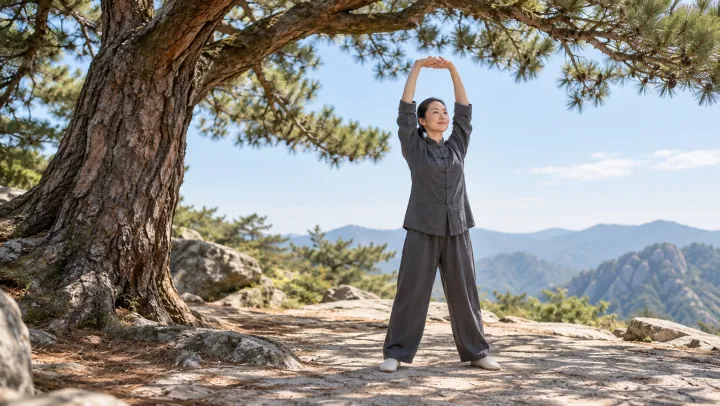
FURTHER READING
Take a closer look.
Read about study timelines, reviewing your practice, and research on specific everyday concerns.
References and sources
Research is described with its participants, course, comparison, and limits.Updated . See Research and Editorial policy.
- 2017 Baduanjin systematic review:Zou L, et al. A Systematic Review and Meta-Analysis Baduanjin Qigong for Health Benefits: Randomized Controlled Trials. Evid Based Complement Alternat Med. 2017;2017:4548706.
Nineteen randomized trials, 1,535 adults; courses lasted 4–24 weeks. Separate sleep and quality-of-life analyses used different samples. The abstract’s balance confidence interval and significance statement are inconsistent, so the card does not summarize balance as a clear favourable result.
- 2021 tai chi sleep trial:Siu PM, et al. Effects of Tai Chi or Exercise on Sleep in Older Adults With Insomnia: A Randomized Clinical Trial. JAMA Netw Open. 2021;4(2):e2037199.
Full text checked: 320 adults aged 60 or older, 12-week classes, 24-month post-course follow-up. Continued practice matters. Checked 2026-10-20.
- 2018 tai chi fall-prevention trial:Li F, et al. Effectiveness of a Therapeutic Tai Ji Quan Intervention vs a Multimodal Exercise Intervention to Prevent Falls Among Older Adults at High Risk of Falling: A Randomized Clinical Trial. JAMA Intern Med. 2018;178(10):1301–1310.
Full text checked: 670 adults aged 70 or older, adapted eight-form program, 24 weeks. The fall-rate result is not an individual prediction. Checked 2026-10-20.
- NCCIH: Qigong overview:National Center for Complementary and Integrative Health. Qigong: What You Need To Know.
Official overview read for practice conditions and the limits of the evidence. Checked 2026-10-20.
Start with one clear lesson.
Before the app launches, explore the illustrated opening and first movement guides.
Learn the steps. Follow the cues. Keep a record.
 Not yet available
 Not yet available