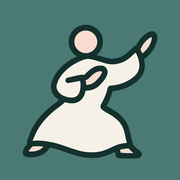
Preparation begins with feet together, then a step out, palms raised to the waist, and hands in front of the abdomen. Part 1 starts by lowering the hands. Closing has its own upward, outward, and downward route after the eight main parts.
Preparation: settle, step out, then bring the hands in
Printed pages 6–9 of the manual use four steps. Page 2 of the illustrated guide combines the last two. Here is the four-step sequence:
- Stand with feet together: stand upright, arms hanging naturally at the sides, looking forward.
- Step out: move the left foot left to shoulder width. Keep the fingers together and arms straight; turn the hands slightly beside the body so the palms angle a little backward.
- Raise the palms to the waist: lift the hands beside the body to waist level, palms up, fingertips pointing toward the sides of the ribs.
- Bring the hands in front of the abdomen: one hand is above the navel and one below it, palms facing each other vertically.
Where are the hands and feet before Part 1?
The feet are shoulder-width apart. The hands are in front of the abdomen, one above and one below the navel, with the palms facing each other. To begin Part 1, lower the hands beside the body before raising the arms sideways.
Feet-together standing at the start of preparation may look similar to the downward arm extension in Part 1, but the foot position and transitions differ. See the Part 1 starting position and sequence.
Closing: lift the hands, separate, and lower
Following page 33 of the illustrated guide, separate the hands in front of the abdomen. With fingertips up and the backs of the fingers together, lift until the fingertips approach the hollow at the front base of the neck. Then separate the hands sideways with the hands hanging downward, lower them along the ribs to the sides of the thighs, and stand naturally for a moment.
This describes the hand route, not pressing the neck. Notice where the hands leave the abdomen, how far they rise, and when they separate. The source’s traditional mental cues do not specify breath-holding durations.
Returning the hands is not always closing
- A step ending: provides the start of the next step. Upright palms in Part 1 are followed by bending the elbows to bring the hands above the head.
- A part returning: Part 1 step 9 returns to the abdomen, but Parts 2–8 follow.
- The routine closing: uses the separate closing route after Part 8.
Check that preparation, the main sequence, and closing come from the same instructions. If you need to stop or feel unwell, do not keep going merely to complete an ending you have not understood.
References and sources
- Mi Jing Zi: Babu Jingang Gong, numbered steps and instructions
Editorial reference scan of Babu Jingang Gong (Chinese title transliterated), credited to Mi Jing Zi: 147 scanned pages, without a text layer. Introduction: printed pages 4–5; preparation: 6–9; Part 1: 13–21. PDF page numbers are 13 higher in these ranges. No public original, publisher, year, edition, or ISBN has been verified for this copy. This link identifies the copy and its pages; it is not an original-file download or clinical evidence.
- Illustrated Babu Jingang Gong: Zhang Zhishun demonstration, 33 pages
Editorial reference scan of Tujie Babu Jingang Gong (Chinese title transliterated), crediting Zhang Zhishun as demonstrator: 33 pages. Preparation: page 2; parts: pages 3–32; closing: page 33. No public original, editor, or publication details have been verified, including its status as an official companion to the manual. This link is a copy-identification note, not an original-file download.