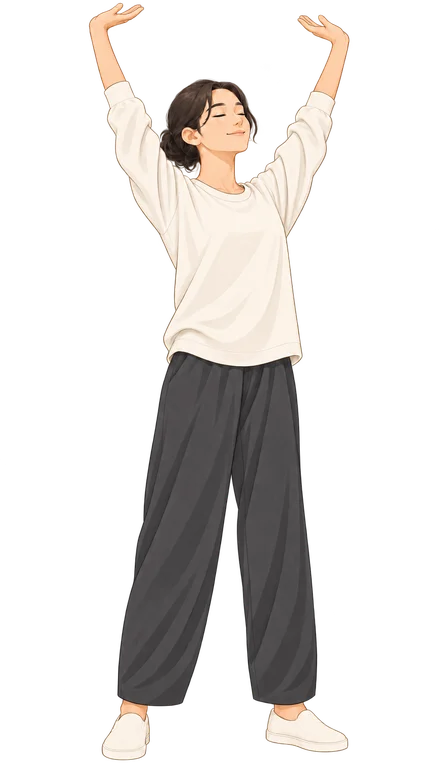
Yoga · First steps
You do not need
to be flexible first.
Choose a clear beginner lesson. Learn support, movement, and how to finish before following a whole class.
- Use supportAsk about chair and wall options
- Check propsPrepare for the chosen lesson
- Two posesMountain and seated Cat–Cow
- UNESCOInscribed in 2016
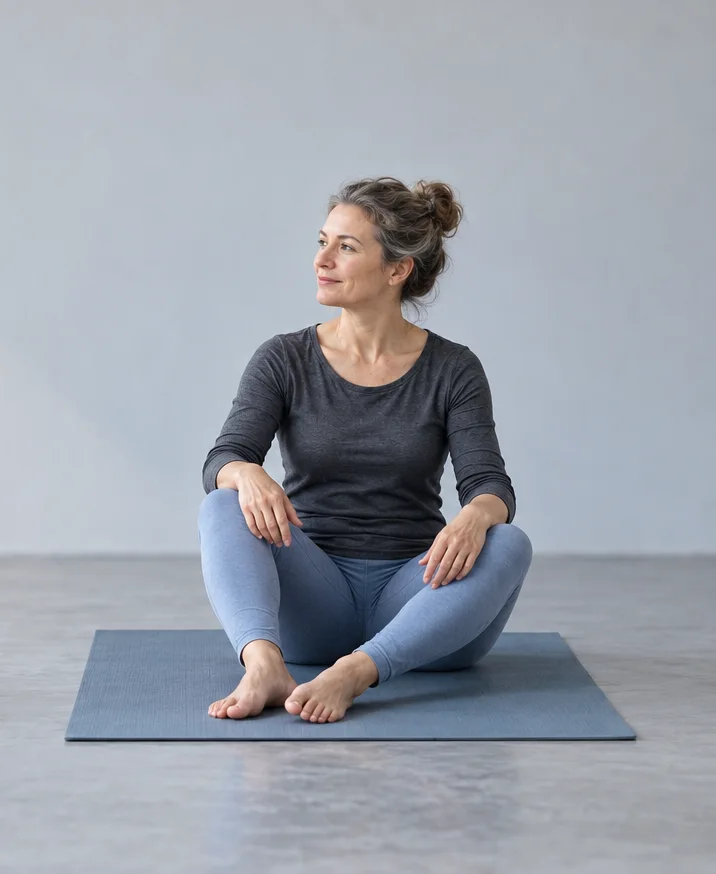
CHOOSING A CLASS
Check the lesson, not just its name.
Hatha, flow, gentle, and chair are useful search terms, but they do not tell you everything about a class. Ask how the teacher explains movement, handles questions, and provides support.
| Feature | What to look for first | What to check more closely |
|---|---|---|
| Instruction | Clear entries, exits, and pauses | Prior knowledge of pose names assumed |
| Pace | Time to watch and understand | Continuous transitions with few explanations |
| Floor work | Explicit alternatives or seated arrangements | Repeated standing-to-floor transitions |
| Hand support | Clearly taught support and alternatives | Repeated loading through hands and wrists |
| Room | Temperature stated in advance | Heated conditions or unclear setup |
| Feedback | A way to ask about a specific difficulty | A demonstration with no explanation or feedback |
These are questions about teaching and physical requirements. A class name alone cannot establish difficulty or suitability.
RETURNING TO PRACTICE
Familiarity comes before a deeper pose.
A useful early aim is to understand a pose’s start, support, and finish. Studies assess longer programs; they do not promise a particular feeling after each practice.
First lesson
Understand one pose
Identify the starting position and the route back to it.
Over several weeks
Recognize the cues
Return to one course so its terms and transitions become familiar.
Over months
Read outcomes separately
Studies measure specific tests and questionnaires over defined programs, not a universal progress schedule.
As learning continues
Choose the next task
More poses, breathing methods, and meditation each need their own instruction.
RESEARCH IN CONTEXT
22randomized trials
A 2019 review studied programs lasting 4–28 weeks in groups with a mean age of at least 60. Some flexibility, balance-test, and sleep-quality results favored yoga over inactive controls. Better balance tests do not establish fewer falls; the later SAGE trial measured falls directly and reported a higher rate in its yoga group.
Read the outcomes and limitsLOW-BACK-PAIN RESEARCH
2,223participants in 21 trials
The 2022 Cochrane review studied adults with chronic nonspecific low back pain. At three months, average function and pain changes versus no exercise were small and below the review’s clinical-importance references. Function probably differed little from other back-focused exercise. Adverse events, mainly increased back pain, were also assessed.
Read the reviewUseful things to notice
Comparing photographs→Understanding support
Notice what supports your body instead of matching the demonstrator’s range.
Unclear endpoints→Knowing how to finish
A pose includes returning and releasing, not just holding its final shape.
Chasing the video→Reviewing a short section
Pause to watch and ask one specific question.
Forcing the breath→Recognizing the cue
Distinguish observing breathing from coordinating it with a movement.
Switching every day→Learning one course
Consistent terminology makes it easier to remember what to review.
These are learning observations, not promised health changes. Research results belong to the programs and participants studied.
HOW TO START
Learn poses, then sourced connections.
Start with Mountain Pose or seated Cat–Cow. Separate floor units explain an identified chair-supported transfer, Child’s Pose entry and exit, and a lying-rest ending.
Choose clear instruction
Check the pace, floor transitions, support, and how to ask questions.
Learn one of two basic poses
Mountain Pose uses standing support; seated Cat–Cow uses a chair and feet. Read the entry and finish before moving.
Use an explained connection
Follow the identified original segment and its support requirements. The separate transfer and pose guides do not combine into a self-made class.
Reading guides available · No First Chi yoga course
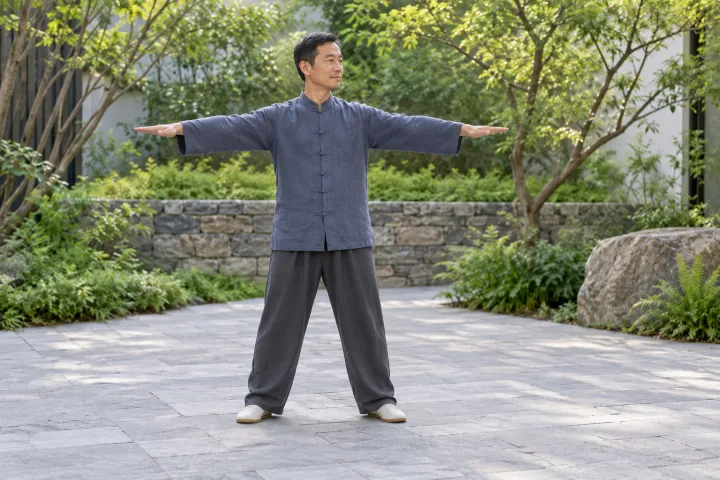
BACKGROUND
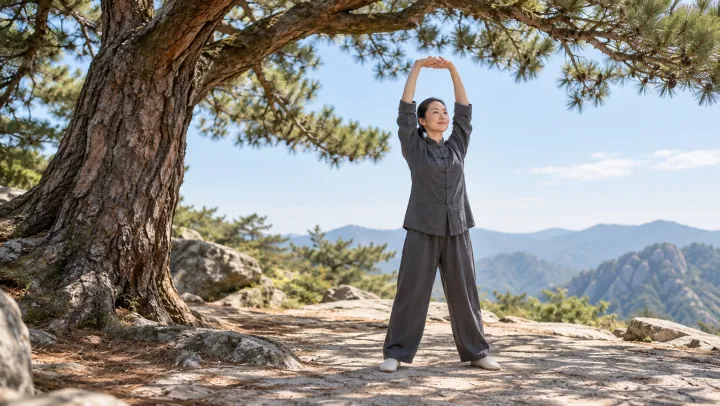
An Indian practice with many approaches.
Yoga is rooted in Indian philosophy and includes more than physical postures. UNESCO’s account describes poses, meditation, breathing, chanting, and other practices, with knowledge passed through teaching traditions.
Modern classes differ in what they emphasize. The British Wheel of Yoga describes formats including Hatha, Vinyasa, Ashtanga, Iyengar, restorative, and chair yoga. The format name is a starting point for asking about a particular lesson.
On December 11, 2014, the United Nations designated June 21 as International Day of Yoga. India proposed the resolution, endorsed by 175 member states. UNESCO inscribed yoga on its cultural heritage list in 2016.
NCCIH cites US national survey estimates showing adult yoga participation rising from 5.0% in 2002 to 15.8% in 2022. These describe participation, not evidence that every participant obtained a particular health benefit.
- 2016UNESCO cultural heritage inscription
- 175member statesEndorsed the UN resolution in 2014
- 15.8%US adult participation in 2022, cited by NCCIH
Further reading
Explore a question
Learn a complete pose, then examine separately sourced floor transfers, an original class transition, and a lying-rest ending. Reading order does not prescribe a class.
Common questions
Before your first class,
a few useful answers.
Can I start yoga if I am stiff?
Flexibility is not an entry test. Check the actual class movements, support, and alternatives. A chair arrangement may help avoid floor transitions, but ask whether the class is fully seated or includes standing.
What should I ask before my first class?
Ask about floor transitions, weight on hands and knees, pace, props, and room temperature. These details are more useful than the word beginner alone.
Is Hatha always easier than Vinyasa?
No. Names describe common approaches, not fixed difficulty levels. Check whether the teacher explains poses separately and what support and transitions are required.
What if I cannot match a breathing cue?
Do not hold your breath while waiting for a movement to finish. Pause the timing and check which phase the cue describes. A separate breathing method should not be added to every posture.
Does research mean any yoga video is suitable for back pain?
No. The review concerns adults with chronic nonspecific low back pain in defined programs. Average changes were small, and adverse events were reported. It does not validate every video or every cause of pain.
Is there a First Chi yoga course?
Not currently. These are reading guides. The homepage’s product demonstration teaches a Jingang Gong example, which is a different practice.
Read the sources
Cultural history comes from institutional sources. Research summaries state the participants and comparisons; source notes identify access limits.Updated .
Explore Mountain Pose.
Start with the feet-apart version: learn foot support, knee position, and how to return to ordinary standing.
A single-pose reading guide
Explore the app courses: Baduanjin · Jingang Gong