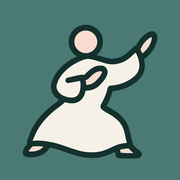
From supported kneeling, move the hips back toward the heels into Child’s Pose, then return to all fours. This version still requires wrist, knee, and foot support. A recovery pose is not automatically comfortable for everyone.
Which part of the NHS class?
The original is Vinyasa flow yoga on the NHS website, produced by InstructorLive and taught by LJ. At about 10:02–11:28, the real sequence is knees down, return to the hands, hips back, Child’s Pose, then all fours. The starting point is already on the mat, with controlled kneeling and hand support. This is not a complete standing-to-floor entry. The preceding Dolphin Pose and following Downward-Facing Dog are outside this unit.
The NHS page describes general exercises for people in good health with a reasonable level of fitness, rather than treatment for a particular condition. NHS hosting does not make the whole approximately 50-minute class suitable for everyone. First confirm that kneeling, hand support, and leaving the floor are manageable. The floor-transfer guide explains a separate source, not a prescribed warm-up for this class.
Identify what the hands and knees support
All fours means both hands and both knees contact the floor. This differs from sitting with hands resting on the thighs. At about 7:34–7:42, the original class places hands or wrists directly beneath the shoulders. Around 10:10, the demonstration shows palms and knees on the mat. We use “hands-and-knees support” to name those contacts, without adding another school’s spacing rules.
Compared with the seated version, this adds palm and wrist loading, kneeling, and a changing foot position as the hips move back. If one contact must be avoided, this version cannot simply be copied unchanged. Ask about a suitable arrangement rather than substituting fists, elbows, or unstable raised supports yourself.
Enter Child’s Pose by moving the hips back
- Follow the source’s return of both knees to the floor and then hand support. Identify the supporting contacts before moving on. In this demonstration, the toes are released and the tops of both feet rest on the mat.
- Move the hips back toward the heels. Keep the arms in front as the trunk lowers toward the mat. The demonstrated version does not bring the hands beside the feet.
- Let the forehead reach the floor or mat to form this version of Child’s Pose. LJ uses it as a recovery position within this class.
Toward the heels describes the direction; it is not an instruction to force the bottom onto them. If kneeling, forehead contact, or the folded position is unsuitable, do not press lower to match a picture. If you need different support or props, ask a teacher to confirm the specific arrangement first.
Return weight to the hands and knees
At about 11:21–11:28, the class returns from Child’s Pose to all fours. Move forward and upward back into hand-and-knee support. The forehead leaves the mat, and the hips no longer remain back toward the heels. This unit ends on the floor, not with standing up.
Distinguish the directions: hips back and trunk lowering enter the pose; forward and upward movement return to the supporting position. The class next tucks the toes for Downward-Facing Dog. That changes the requirements again and is not a compulsory finish to this short unit.
Check the transition, not how low you folded
Two useful questions are whether the hands remain clearly in front as the hips travel back, and what supports you after the forehead leaves the mat on the return. These questions address the transfer rather than stretch depth.
This segment does not provide individual modifications for wrist, knee, or spine conditions. Get specific guidance for activity restrictions. A recovery position is not a substitute for stopping with pain, dizziness, or clear discomfort. Use the separate review and feedback article to organise a question for a teacher; this article supplies the actual movement sequence.
References and sources
- NHS: Vinyasa flow yoga, taught by LJ / produced by InstructorLive
On 2026-10-20, read the complete NHS page and all official English captions for its embedded video; inspected relevant official thumbnail frames for support and practitioner-side directions. This is not a frame-by-frame technical review of the whole video. Video ID 3216857453001. Uses Child’s Pose/all fours at about 10:02–11:28 and final lying rest/right-side roll/left-arm rise at 44:40–49:05. Does not adopt Dolphin, Downward-Facing Dog, inversions, deeper backbends, mechanisms, or health claims. NHS describes general exercise for people in good health with a reasonable fitness level, not condition-specific treatment. The approximately 50-minute class is not a beginner dose set by this site.
- NCCIH: Yoga—Effectiveness and Safety
Read the definitions, variation between programs, beginner considerations, and survey figures. This overview does not validate a particular online course.