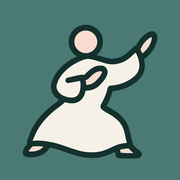
From horse stance, extend one fist, open and turn the hand, then close and return it. Alternate sides. Finish with feet together and hands released.
Step and form the fists
This continues the same standing Health Qigong Baduanjin used in the first three lessons. The route follows the General Administration of Sport demonstration around 11:18–12:22, checked against the 2018 technical corrections. Left and right mean your own sides. Times locate the passage, not a required personal pace or range.
- Complete the sixth movement’s final downward palm press in front of the lower abdomen. Shift weight right, step the left foot left and gradually bend into horse stance.
- Form the version’s enclosed-thumb fist and bring both fists beside the waist, thumb sides up. First fold the thumb toward the base of the ring finger; close the other four fingers together around it, rather than curling them one at a time from the little finger.
- Keep a stable stance and look forward before extending the left fist. Do not squeeze the thumb joint or grip until it hurts.
This lesson uses the 2018 corrections and the same continuous demonstration. If another source counts a wrist circle from a different starting point, distinguish the versions rather than joining their instructions.
Extend the left fist, then open the hand
- Leave the right fist at the waist. Slowly extend the left fist forward around shoulder height, thumb side up and elbow slightly bent. Do not strike sharply or lock the elbow.
- Follow the fist’s direction with the gaze and gradually widen the eyes. Do not add jaw clenching or a breath hold to create the traditional intense look.
- After extension, rotate the forearm inward and open the fist, turning the thumb downward. Bend and turn the wrist to a sideways hand with fingers pointing to your right and palm forward.
The extension is not the end of this side. Around 11:26–11:30, locate the change from fist to open hand before continuing the wrist turn.
Turn the wrist, close and return
- From the left hand pointing right with palm forward, turn at the wrist so the fingertips pass upward, leftward and downward. Keep a slight elbow bend.
- After that route, fold the thumb first and close the four fingers together around it again. Do not keep the fist clenched and rotate only the whole arm.
- Bend the left elbow and draw the fist to the waist, thumb side up. Return the gaze forward before changing sides.
The 2018 text describes about 270 degrees from the sideways-hand position. The directional route here identifies that passage; it is not a target for forceful twisting. Watch about 11:29–11:35 for opening, turning, closing and withdrawing.
Change sides, then finish with feet together
- Keep the left fist at the waist. Slowly extend the right around shoulder height, thumb side up, looking in its direction.
- Open and rotate the right hand with the thumb turning down. From fingers pointing left and palm forward, pass the fingers upward, rightward and downward. Close again and return to the right waist.
- The demonstration performs three extensions on each side. After the final right return, shift weight right and draw the left foot in beside the right while straightening.
- Release both fists and let the open hands hang at the sides, looking forward. This prepares the eighth movement’s heel rise and return. Do not begin the heel movement in horse stance.
Check what happens after extending
- If you withdraw immediately, you have omitted opening, turning and closing the hand.
- If both fists extend together, compare the alternating route with the other fist at the waist.
- If the shoulder or torso swings to force the wrist around, review the sideways-hand starting point instead.
- If you lunge forward or lock the elbow, compare the slow extension and slight elbow bend.
This is a traditional movement name and sequence, not striking practice or a guarantee of strength or treatment effects.
Begin with natural breathing. A brief pause does not require holding your breath or forcing a larger movement. Traditional names identify the sequence; health effects need separate research evidence.
References and sources
- General Administration of Sport: continuous Health Qigong Baduanjin demonstration
Science and Education Department, 21 May 2022. The Chinese edition records checks of the opening and first three movements on 17 October 2026. Timestamps locate passages, not a required personal pace. The initial English check accessed the hosting page only; the opening and first three movement account still relies on the earlier review. No video is republished. On 20 October 2026, reviewed time-sampled frame sequences around 06:24–13:26 of the same original file, with its SHA-256 matching the earlier ledger. This covers movements four to eight and the closing arc, generally sampled every one or two seconds and every half second for the wrist passage. The film ends with overlapping hands; the later release follows the written corrections. No new audio transcript, copied film or frame images are published.
- Health Qigong Administrative Center: common Baduanjin errors and corrections
Gong Lihui and Cai Li, 10 January 2018. Rechecked the opening and first three movements: hand height, gaze, bow hand shapes and routes, palm orientation, single-hand lifts and returns. Technical descriptions are not personal range-of-motion prescriptions. Full text reread on 20 October 2026 for movements four to eight and closing: arm rotation and level gaze, light thigh contact and head/pelvis routes, hand descent and arm-led rise, wrist route and enclosed-thumb fist, controlled heel descent and final release.
- Health Qigong Administrative Center: breathing methods and learning stages
Gong Lihui, 12 June 2018. Used for the distinction between natural breathing when beginning Baduanjin and later coordination. It does not prescribe a personal breathing rate or breath-hold duration.