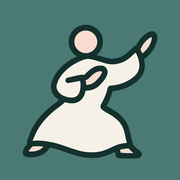
With feet together, raise both heels smoothly, pause and lower with control. Keep the forefeet grounded. After this group, continue into the closing.
Complete the step together first
This continues the same standing Health Qigong Baduanjin used in the first three lessons. The route follows the General Administration of Sport demonstration around 12:18–13:10, checked against the 2018 technical corrections. Left and right mean your own sides. Times locate the passage, not a required personal pace or range.
Continue from the seventh movement’s final step and hand release: the left foot has returned beside the right, both legs are upright, the fists are open and hands hang at the sides. Face forward and settle before raising the heels.
This requires standing with feet together and bearing weight through the front of the feet. If balance or foot and ankle movement is limited, establish appropriate support first. This page does not invent a chair-supported or seated substitute.
Rise upward without leaning
- Lengthen upward through the spine, release the shoulders and keep the legs naturally straight. Leave the arms beside the body with the fingers extending down.
- Raise both heels smoothly as weight moves onto the front of the feet. Keep the toes in contact with the ground and rise upward rather than reaching the head forward or leaning backward.
- Pause within a position you can control, still looking forward. Do not jump or rock to raise the heels farther.
The corrections identify excessive forward-and-back weight movement and head sway as errors. They describe upright, close legs during the rise. Check stable upward movement before focusing on height.
Lower smoothly rather than dropping
- Let the heels descend smoothly while the body remains upright. Do not deliberately stop midway and then drop abruptly.
- Return the heels to the ground with a gentle settling action and release the shoulders and body. Let the teeth meet lightly rather than clenching the jaw or stamping for impact.
- Regain a stable stance before the next rise. The forefeet do not leave the floor in a jump, and the feet are not lifted and stamped down.
The 2018 corrections describe an even descent and a gentle, appropriate return. They set no universal height or force. Stop if the descent causes pain, dizziness or marked discomfort.
Count the version, then continue to closing
This demonstration counts one rise and descent as one repetition and performs seven. That records its arrangement; it does not require every reader to copy the height, pace or number.
After the final descent, keep the feet together and hands at the sides. Continue with the closing arm arc, abdominal hand placement and release. Do not walk away immediately or reopen the stance for the first movement.
Check forward-and-back rocking
- If the head reaches forward or the body leans back, review the upward direction and controlled support through the front of the feet.
- If pressure shifts only onto the big toes, review contact across the toes and forefeet instead of collapsing inward.
- If both feet leave the ground, the action has changed into a jump.
- If each descent gets louder, do not treat sound as a target or increase height to produce it.
The traditional name refers to dispelling illnesses. It does not mean heel movements cure every disease.
Begin with natural breathing. A brief pause does not require holding your breath or forcing a larger movement. Traditional names identify the sequence; health effects need separate research evidence.
References and sources
- General Administration of Sport: continuous Health Qigong Baduanjin demonstration
Science and Education Department, 21 May 2022. The Chinese edition records checks of the opening and first three movements on 17 October 2026. Timestamps locate passages, not a required personal pace. The initial English check accessed the hosting page only; the opening and first three movement account still relies on the earlier review. No video is republished. On 20 October 2026, reviewed time-sampled frame sequences around 06:24–13:26 of the same original file, with its SHA-256 matching the earlier ledger. This covers movements four to eight and the closing arc, generally sampled every one or two seconds and every half second for the wrist passage. The film ends with overlapping hands; the later release follows the written corrections. No new audio transcript, copied film or frame images are published.
- Health Qigong Administrative Center: common Baduanjin errors and corrections
Gong Lihui and Cai Li, 10 January 2018. Rechecked the opening and first three movements: hand height, gaze, bow hand shapes and routes, palm orientation, single-hand lifts and returns. Technical descriptions are not personal range-of-motion prescriptions. Full text reread on 20 October 2026 for movements four to eight and closing: arm rotation and level gaze, light thigh contact and head/pelvis routes, hand descent and arm-led rise, wrist route and enclosed-thumb fist, controlled heel descent and final release.
- Health Qigong Administrative Center: breathing methods and learning stages
Gong Lihui, 12 June 2018. Used for the distinction between natural breathing when beginning Baduanjin and later coordination. It does not prescribe a personal breathing rate or breath-hold duration.