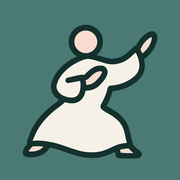
Keep the shoulder-width stance after Drawing the Bow. One hand rises in front and turns palm-up above the same side of the head while the other presses palm-down beside the hip. Return both palms up to the abdomen between sides. At the final return, both palms finish down beside the hips.
From Drawing the Bow into Raising One Hand
Raising One Hand (Dan Ju), also called Separate Heaven and Earth, follows the second movement in the same Health Qigong version. Directions refer to your own body. The demonstration locates the second movement’s final return around 05:04–05:12 and the third movement around 05:12–06:24. Technical details follow the original corrections.
- Complete the second movement’s return: after bringing the right foot in, feet are parallel and about shoulder-width apart. Face forward with knees slightly bent and palms up at the abdomen, fingertips towards one another. Review the final return if needed.
- Keep that stance and separate the hands: the left will move up and the right down. Do not step into the wide horse stance again or repeat the wrist-crossing, outward palm and drawing claw.
Restrictions in the shoulders, neck, back or knees need consideration before this lift and bend. Stop for pain, dizziness or marked discomfort; do not force the height through leaning back or pressing joints.
Left hand up, right hand down
- Lift the left palm from the abdomen: the hand leads the elbow upward past the chest towards the face, initially palm-up. Do not lift the elbow sideways first and swing the hand beside the head.
- Turn and press upward past the face: rotate the forearm so the hand moves above the left side of the head. At the end the palm faces straight up, fingers right. Extend the wrist enough for the upward palm, keeping a slight elbow bend.
- Turn the right palm down at the same time: press from the abdomen to beside the right hip, palm down, fingers forward and elbow slightly bent. Do not wait for the left hand to finish or push forcefully towards the floor.
- Gradually straighten the legs: rise as the hands extend in opposite directions, head and torso upright, gaze forward. Keep heels grounded; do not add a heel lift or side bend.
The upper hand finishes above the same side of the head, rather than far forward or far sideways. The corrections specify an upward palm and slightly bent elbow. Do not turn the opposing reach into shrugged shoulders, an arched back or a held breath.
Return to the abdomen before changing sides
- Turn the left palm and lower it: rotate the arm and bend the elbow, following the route back in front of the face and chest. Do not make a large outward circle.
- Return both palms upward at the abdomen: the right hand also turns up and returns. Fingertips face one another; hands do not grip or cross.
- Bend the knees slightly with the return: lower upright, without folding to bring the hands down. Feet stay put; do not sway sideways towards the upper hand.
- Exchange the roles: from the abdomen, raise the right and lower the left. Do not move the overhead hand straight across the head to switch sides.
The correction text says the rising and lowering hand follows the corresponding arc in front; the finger route may reach but should not cross the body’s centre line. It does not mean both hands move together at one height. The first side change is around 05:18–05:28 in the demonstration.
Right hand up, left hand down
- Raise the right hand past the chest and face: the hand leads the elbow, turns near the face and presses above the right side of the head. Finish palm-up, fingers left, elbow slightly bent.
- Press the left hand beside the left hip: palm down and fingers forward. Do not leave it overhead and raise both hands.
- Let the legs extend naturally: remain facing forward. Avoid leaning left or keeping the head tipped up to watch the upper palm.
- To repeat, return to the abdomen: lower the right hand in front of the face and chest, turn both palms up and bend the knees slightly. Next comes left up/right down. Do not step out and in again.
The hand roles and return correspond to the left side. See around 05:24–05:36 in the demonstration, alongside the palm and centre-line requirements in the corrections.
Which way does each palm face?
| Stage | Left palm | Right palm |
|---|---|---|
| Starting position and ordinary return | Up at the abdomen, fingertips towards the right hand. | Up at the abdomen, fingertips towards the left hand. |
| Left-up/right-down endpoint | Above the left side of the head, palm up, fingers right. | Beside the right hip, palm down, fingers forward. |
| Right-up/left-down endpoint | Beside the left hip, palm down, fingers forward. | Above the right side of the head, palm up, fingers left. |
| Final return | Remains down beside the left hip. | Lowers in front and finishes down beside the right hip. |
Palms turn during the movement, so an endpoint picture does not describe the whole route. Both palms face up in an ordinary return and down at the final ending. Those positions prepare different next actions.
Why do both hands finish at the hips on the last return?
The demonstration shows three left-up and three right-up repetitions, ending with the right hand overhead. This describes the arrangement, not a minimum personal dose or a required hold time.
- Lower the right palm in front: rotate the arm and bend the elbow, coming down past the face and chest.
- Continue down beside the right hip: instead of returning palm-up at the abdomen, turn it down beside the hip. Leave the left hand in its down position rather than bringing it back up.
- Finish with both palms beside the hips: fingers forward, elbows slightly bent. The knees bend slightly as the hands lower; remain upright with feet about shoulder-width apart. This prepares the fourth movement.
See the last return around 06:18–06:24 in the demonstration. The fourth movement’s arm rotation and backward look follow next; do not turn the head early. This is not the full set’s closing. See the complete order.
What if the palm tilts, the body leans or the sides get confused?
- Upper palm faces forward and up: check the forearm turn near the face and the endpoint. Do not force only the wrist instead of learning the palm turn.
- Hand crosses over the head: check the centre line. The route is above the same side and back in front, not a side stretch across the head.
- Only the upper hand moves: check that the lower palm turns from the abdomen and presses beside the hip. One hand up does not mean only one hand works.
- You lean, arch or shrug to reach: reduce the range and keep the torso upright. Do not compensate to match the demonstration’s height.
- You lose the side change: check for the ordinary palms-up return and distinguish it from the final palms-down ending.
Route and palm details follow the technical source. Use natural breathing while learning; a pause does not require a breath hold, and the two hands do not represent separate inhale/exhale commands. See the breathing source.
The traditional longer name refers to the spleen and stomach. That name does not establish treatment of digestive conditions. For measured outcomes, read Baduanjin health research.
References and sources
- General Administration of Sport: continuous Health Qigong Baduanjin demonstration
Science and Education Department, 21 May 2022. The Chinese edition records checks of the opening and first three movements on 17 October 2026. Timestamps locate passages, not a required personal pace. The initial English check accessed the hosting page only; the opening and first three movement account still relies on the earlier review. No video is republished. On 20 October 2026, reviewed time-sampled frame sequences around 06:24–13:26 of the same original file, with its SHA-256 matching the earlier ledger. This covers movements four to eight and the closing arc, generally sampled every one or two seconds and every half second for the wrist passage. The film ends with overlapping hands; the later release follows the written corrections. No new audio transcript, copied film or frame images are published.
- Health Qigong Administrative Center: common Baduanjin errors and corrections
Gong Lihui and Cai Li, 10 January 2018. Rechecked the opening and first three movements: hand height, gaze, bow hand shapes and routes, palm orientation, single-hand lifts and returns. Technical descriptions are not personal range-of-motion prescriptions. Full text reread on 20 October 2026 for movements four to eight and closing: arm rotation and level gaze, light thigh contact and head/pelvis routes, hand descent and arm-led rise, wrist route and enclosed-thumb fist, controlled heel descent and final release.
- Health Qigong Administrative Center: breathing methods and learning stages
Gong Lihui, 12 June 2018. Used for the distinction between natural breathing when beginning Baduanjin and later coordination. It does not prescribe a personal breathing rate or breath-hold duration.