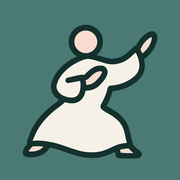
From the first movement’s palms-up return, step left and cross the wrists in front of the chest. Bend into the horse stance as one hand pushes sideways and the other draws. Release the drawing hand before shifting weight and bringing the foot in. The final return keeps a shoulder-width stance.
Drawing or Opening the Bow: is this the same movement?
This continues the opening and first movement in the same standing Health Qigong version. Drawing the Bow (Zuo You Wan Gong) is also called Opening the Bow in some translations. The official Chinese demonstration and correction text use Kai Gong, while the earlier official movement list uses Wan Gong. These identify the same position in this sequence, not an extra movement.
Directions refer to your own body. Do not copy screen-left as your left in a front-facing video. In the official demonstration, about 03:40 locates the transition and 03:45–05:10 the sides and final return. These locate passages, not a personal speed target. Hand details are checked against the original technical corrections.
From the first movement: step and cross before bending
- Keep the first movement’s ending position: feet about shoulder-width apart, knees slightly bent, palms cupped upward in front of the abdomen. Do not repeat the feet-together opening or interlace for another overhead lift.
- Step left: shift weight onto the right leg so the left foot can move sideways into a wider stance. Once the foot settles, return the body between the feet.
- Cross the wrists in front of the chest: bring the hands up from the abdomen with the left palm outside, both palms towards the body and fingertips around shoulder height. Leave space in front of the chest and avoid pinning the elbows in. The legs are naturally straight here; the bow-drawing knee bend comes next.
The corrections distinguish crossing after the step from bending while drawing the bow. Do not imitate the lowest stance if it is unsuitable. Consider restrictions on side stepping, knee bending or arm lifting, and stop for pain, dizziness or marked discomfort.
What are the pushing palm and drawing claw?
The outward palm: spread the thumb and index finger, with the index pointing up. Curl the other three fingers. The source specifies bending the two joints nearer each fingertip while keeping the base joint extended; do not close all three fingers into a fist. This is not the two-fingers-together sword-hand shape.
The drawing claw: curl all five fingers, including the thumb rather than pointing it up. Again, the four fingers do not fold tightly at their base joints. The shape resembles holding a bowstring, but there is no actual bow to grip hard. The elbow leads the drawing route; squeezing the fingers does not create the pull. See the source corrections.
First identify which hand pushes and which draws, then study its shape. Do not force finger joints into position with the other hand when the shape is uncomfortable.
Draw left: left palm out, right hand back
- Separate from the wrist-crossing: form the outward palm with the left hand and push left. Form the claw with the right, letting the right elbow lead horizontally until the hand is in front of the right shoulder.
- Bend both knees: lower upright into a centred horse stance, keeping weight between the feet. Do not let the right elbow pull the body to the right or turn it into a one-leg-loaded stance.
- Check palms and height: the left wrist is upright, palm facing left and index up. The right claw faces the body, back of the hand outward, elbow opening to the right. The left wrist and right elbow are approximately at shoulder height.
- Turn the head and gaze left: look towards the left index finger. The chest still faces forward; do not twist the whole torso left to gain reach.
The source identifies drifting towards the drawing hand as an error. The weight shift in the next passage belongs to the transition, not this centred bow position. Keep the knees aligned with the toes.
After the left side: open the right hand before closing the step
- Release the right claw: open the hand and pivot around the right elbow. The fingers swing upward above head height, then lower to the right side at shoulder height with an upright wrist. Do not draw a flat forward arc or shrug the shoulder to circle the hand.
- Now shift weight onto the right leg: the left leg gradually extends as the right supports you, with the arms open at the sides. Distinguish this transition from the centred horse stance.
- Bring the left foot towards the right: gradually rise as both palms arc down at the sides, rotating with the arms. Bring them together in front of the abdomen with palms up, returning the gaze forward.
This brings the left foot close before the right foot steps out next. Do not leave both feet planted and merely exchange the hands. The upward arc is described in the corrections; the foot and hand return can be located around 03:52–03:59 in the demonstration.
Draw right: exchange the hands and stepping foot
- Step right: load the left leg so the right foot can move out. Once it settles, return the body between the feet.
- Cross with the right palm outside: bring both palms up from the abdomen facing the body, with legs naturally straight. Do not keep the left palm outside from the previous side.
- Bend and draw right: the right outward palm faces right, index up. The left claw draws horizontally with the left elbow leading, ending in front of the left shoulder, palm towards the body. Keep the horse stance centred, right wrist and left elbow near shoulder height, and gaze towards the right hand.
- For another repetition: open the left claw and arc it upward around the elbow, then to the left at shoulder height. Shift weight left, bring the right foot towards the left and lower both hands to the palms-up position at the abdomen. Step left for the next side.
Turning the face right alone does not exchange the whole movement. The pushing hand, drawing hand, outer crossed palm, supporting leg and returning foot all change. The first right-side repetition is around 04:00–04:10 in the demonstration.
How is the last return different?
The demonstration has three left and three right repetitions, ending on the right. This describes the version, not a minimum exercise dose. Learn a complete left/right sequence before trying to keep a count.
- Open the left hand after drawing right: release the claw and follow the upward-then-sideways arc, shifting weight onto the left leg.
- Bring the right foot in only to shoulder width: do not close it near the left foot as if preparing another repetition. Keep the parallel stance for the next movement.
- Lower both hands at the sides: return upright and gradually bend the knees slightly. Finish with palms up at the abdomen, fingertips towards one another.
See about 05:04–05:12 in the continuous demonstration. This prepares for Raising One Hand; it is not the closing of the full Baduanjin set. If reviewing only this movement, settle before lowering your arms to end the short practice, without relabelling that as the standard closing.
A quick check of palms and feet
| Stage | Hands and feet | Do not confuse it with |
|---|---|---|
| Cross after stepping | Palms face the body; left outside to draw left, right outside to draw right. Legs initially straight. | Interlacing fingers or bending early while waiting for the hands. |
| Draw the bow | Outward palm faces its side; drawing claw faces the body. Centred horse stance. | Punching forward, dropping the drawing elbow or drifting towards it. |
| Open the drawing hand | Arc up, then out to shoulder height; shift weight now. | Simply crossing both hands again at the chest. |
| Ordinary return | Bring one foot close, lower palms to the abdomen and turn them up. | Skipping the return and next outward step. |
| Final return | Bring the right foot in to shoulder width, palms up at the abdomen. | A narrow stance or the full set’s closing. |
If I cannot keep up, which part should I review?
Study one complete side: crossing—drawing—opening the drawing hand—returning the foot and hands. Once you recognise the end, connect the other side. If the body leans towards the drawing hand, check weight placement. If you lose track of the next foot, check whether you skipped the return.
Do not attempt a low stance, precise finger shape, speed and breathing rhythm all at once. Use natural breathing and avoid holding your breath in the extended position. The official breathing text describes learning coordination in stages.
Return to the sequence list or review guide as needed. This movement’s name and hand shape are not evidence of treatment effects.
References and sources
- General Administration of Sport: continuous Health Qigong Baduanjin demonstration
Science and Education Department, 21 May 2022. The Chinese edition records checks of the opening and first three movements on 17 October 2026. Timestamps locate passages, not a required personal pace. The initial English check accessed the hosting page only; the opening and first three movement account still relies on the earlier review. No video is republished. On 20 October 2026, reviewed time-sampled frame sequences around 06:24–13:26 of the same original file, with its SHA-256 matching the earlier ledger. This covers movements four to eight and the closing arc, generally sampled every one or two seconds and every half second for the wrist passage. The film ends with overlapping hands; the later release follows the written corrections. No new audio transcript, copied film or frame images are published.
- Health Qigong Administrative Center: common Baduanjin errors and corrections
Gong Lihui and Cai Li, 10 January 2018. Rechecked the opening and first three movements: hand height, gaze, bow hand shapes and routes, palm orientation, single-hand lifts and returns. Technical descriptions are not personal range-of-motion prescriptions. Full text reread on 20 October 2026 for movements four to eight and closing: arm rotation and level gaze, light thigh contact and head/pelvis routes, hand descent and arm-led rise, wrist route and enclosed-thumb fist, controlled heel descent and final release.
- Health Qigong Administrative Center: breathing methods and learning stages
Gong Lihui, 12 June 2018. Used for the distinction between natural breathing when beginning Baduanjin and later coordination. It does not prescribe a personal breathing rate or breath-hold duration.
- General Administration of Sport of China: Eight Baduanjin movement shapes
Published 6 March 2013. Chinese names and order of the eight movements; still images do not replace full routes and transitions. English-name verification is recorded separately.