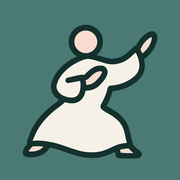
Part 3 starts with fists and a step out. Move both hands to one side, open them, raise one and press the other down. Rotate the forearms, close the fists, return to the abdomen, and repeat on the other side.
Start with fists at the abdomen
Single-Hand Raise (Tiao Li Pi Fu Xu Dan Ju) continues from Part 2 with fists facing each other in front of the abdomen. Step the left foot out, move both fists left, then raise the left hand and press the right down. Hand roles and the bending knee change together on the other side.
Left and right refer to your own sides, not the sides of a front-facing screen.
Steps 1–4: step out, move the fists, open the hands
- Prepare the fists: hold them facing each other above the navel, palm sides upward. The manual describes folding the four fingers inward and placing the thumb against their nails.
- Step left: move the left foot out to the left.
- Move both fists left: bring them together toward the left side of the body.
- Open into palms: hold the left palm upright, facing forward. Place the right hand flat, palm down, with the middle of its back touching the heel of the left palm.
Printed page 41 says outside the left waist, while its photograph and the illustrated guide show a higher position. This article retains that discrepancy and describes the left side of the body without imposing one additional height.
Steps 5–7: raise and press, turn, draw fists together
- Raise and press: bring the left palm up beside the ear, palm upward and fingertips backward. Press the right palm down, fingertips left. Bend the left knee while keeping the head and trunk upright.
- Rotate the forearms: turn both inward. The left palm becomes upright, facing right with fingertips up; the right hand hangs downward, palm left and fingertips down.
- Close the fists and draw together: pull the left fist down and lift the right fist until they face each other below the left chest. Straighten the left leg at the same time.
The hands move in opposite directions together, then draw together on the return. Keep the palm rotation between those phases.
Step 5 has the left palm facing up with fingertips backward. Step 6 has fingertips upward. These are different positions.
Steps 8–9: return to the abdomen and change sides
Keep the feet in their open stance after drawing the fists together on the left.
- Return to the abdomen: move both fists together from the left side to the abdomen.
- Raise and press on the right: move both fists right and repeat in the opposite direction. The right hand rises, the left presses down, and the right knee bends.
The manual counts both sides together. It specifies drawing the left foot back to shoulder width at the end of the part. That final return differs from changing sides; do not step out anew every time.
Which hand rises when the left knee bends?
On the left side, the left hand rises, the right presses down, and the left knee bends. On the return, the left fist pulls down, the right lifts, and the left leg straightens. Reverse all of these on the right. Identify the leg as well as the higher hand.
Separate changing sides from finishing the part
After the left side, move the fists back to the abdomen and then right while keeping the open foot position. Draw the left foot back to shoulder width when finishing the part. These are two different transitions.
Next comes Part 4, circles and drawing the bow.
References and sources
- Babu Jingang Gong, Part 3: printed pages 39–47
Reference for Part 3 step numbers and wording. In this scan the PDF page count is 13 higher than the printed number; check the contents when using another scan.
- Illustrated Babu Jingang Gong, pages 11–13
Used to compare positions, routes, and grouping. Website diagrams were made separately; the guide’s photographs are not reproduced.